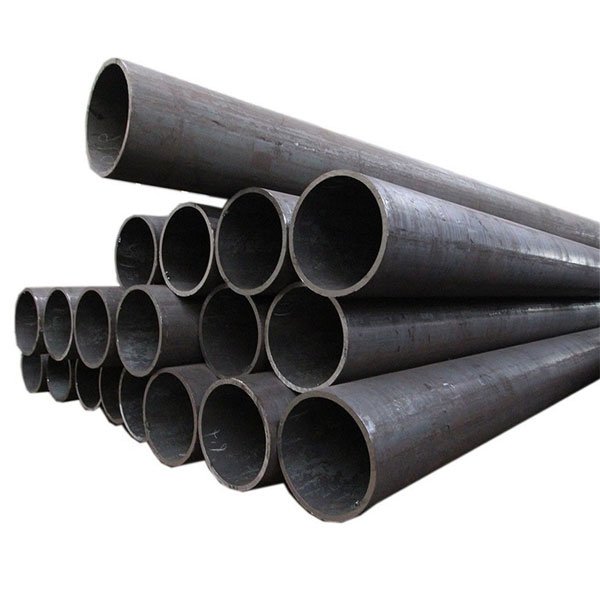
SMLS stands for Seamless Steel Pipe — a pipe formed from a solid steel billet with no welded seam. SMLS pipe is manufactured without a longitudinal or spiral weld seam. This makes it a common choice for pressure piping, high-temperature service and applications where seamless construction is specified.
At JS FITTINGS, hot-finished SMLS runs from 2″ to 30″ OD and cold-drawn from 1/4″ to 18″, supplied to ASTM A106, ASTM A53, ASTM A333 and API 5L (Gr.B–X70, PSL1/PSL2). If you are sourcing for a pressure line, the grade, schedule and test scope matter more than the word “seamless” alone.
Seamless pipe is not automatically the right answer. It costs more than welded pipe and takes longer to source in large diameters. This guide sets out what SMLS actually means, the sizes you can buy, how it compares with ERW and LSAW, and what to put in a purchase order so the quotation you receive is comparable.
What is seamless steel pipe (SMLS)?
A seamless steel pipe has no longitudinal or circumferential weld. It starts as a solid round billet, which is heated and pushed or pulled over a piercing rod until the steel opens into a hollow tube. The pipe is then rolled, sized and finished. No longitudinal pipe-body weld seam is required for weld-seam inspection, but other applicable material and product inspections remain necessary.
That structure gives SMLS three practical advantages:
- Pressure capability. No longitudinal manufacturing weld seam. This eliminates weld-related manufacturing concerns associated with the pipe body, although the finished pipe still requires appropriate material testing, dimensional inspection and quality verification.
- Uniformity. Wall thickness and roundness are consistent, which helps when the pipe must be bent, threaded or machined.
- Service range. SMLS pipe is frequently considered for demanding pressure and temperature applications.
The abbreviation appears in different forms — SMLS, seamless, Seamless CS pipe — but they all describe the same product. On a mill certificate or purchase order, the standard and grade define the pipe far more precisely than the manufacturing word does.
How SMLS pipe is made
Two routes cover most of the market:
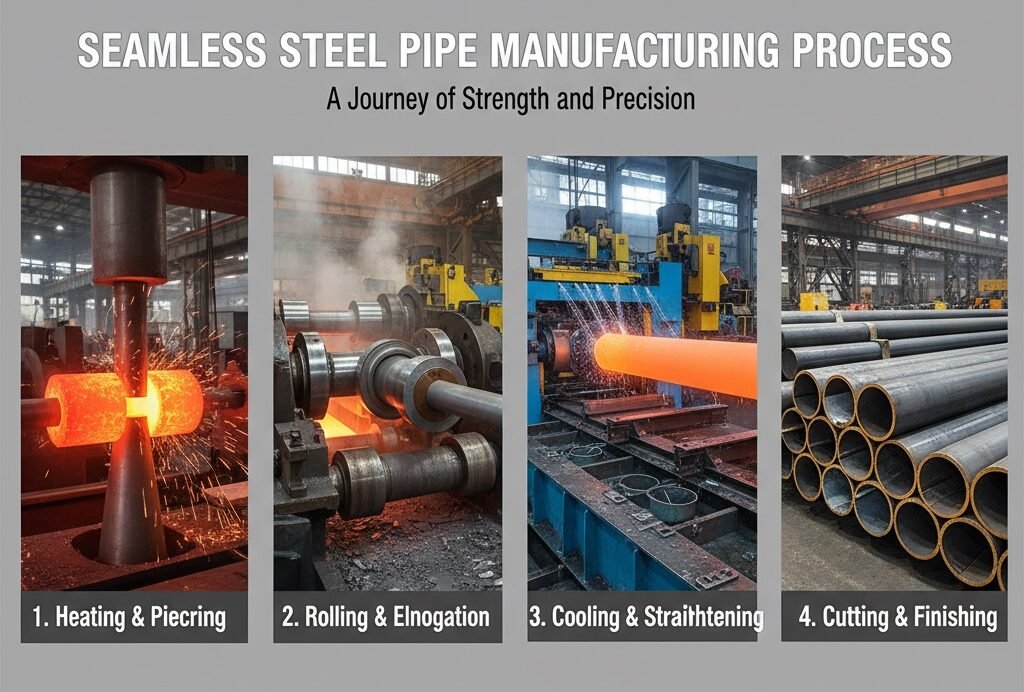
Hot rolling (most common). The billet is heated, pierced by a mandrel, elongated and rolled to the target diameter and wall, then cooled, straightened and cut to length. Hot-finished pipe covers the larger diameters and heavier walls, typically 2″–30″ OD at JS FITTINGS.
Cold drawing (for precision). The pipe is pulled through a die at room temperature. The result is a better surface finish and tighter dimensional tolerance, used where diameter and wall accuracy matter. Cold-drawn supply normally runs from 1/4″ to 18″ OD.
The route affects price and availability. If your specification allows either, ask the supplier which route they are quoting before comparing numbers.
SMLS, ERW and LSAW at a glance
| Feature | SMLS pipes | ERW pipes | LSAW pipes |
|---|---|---|---|
| Manufacturing | Billet piercing and rolling | Coil forming and resistance welding | Plate forming and submerged arc welding |
| Weld seam | No pipe-body weld seam | Longitudinal weld | Longitudinal weld |
| Typical application | Pressure piping, high-temperature service | Water, gas and general industrial pipelines | Large-diameter transmission pipelines |
| Diameter range | Small to large, depending on mill capability | Small to medium | Medium to large |
| Wall thickness | Depends on mill and production route | Depends on manufacturing capability | Heavy-wall options available |
| Cost | Generally higher than comparable ERW | Generally economical | Depends on diameter, wall and order |
| Inspection | Material, dimensional, hydrostatic and applicable NDT | Includes weld inspection and other specified tests | Includes weld inspection and other specified tests |
A search for SMLS vs ERW pipe goes into more detail on the welded alternative. The short version: ERW is not a lower grade of pipe, and SMLS is not automatically the safer buy. The specification decides.
SMLS pipe sizes and wall thickness
SMLS is strongest in small and medium diameters. Large-diameter seamless exists, but availability narrows and price rises sharply above roughly 20″ OD, where welded pipe becomes the practical option.
| NPS | OD (mm) | SCH 40 WT (mm) | SCH 80 WT (mm) |
| 1/2″ | 21.3 | 2.77 | 3.73 |
| 3/4″ | 26.7 | 2.87 | 3.91 |
| 1″ | 33.4 | 3.38 | 4.55 |
| 1-1/2″ | 48.3 | 3.68 | 5.08 |
| 2″ | 60.3 | 3.91 | 5.54 |
| 3″ | 88.9 | 5.49 | 7.62 |
| 4″ | 114.3 | 6.02 | 8.56 |
| 6″ | 168.3 | 7.11 | 10.97 |
| 8″ | 219.1 | 8.18 | 12.70 |
| 10″ | 273.1 | 9.27 | 15.09 |
| 12″ | 323.9 | 10.31 | 17.48 |
Nominal wall thickness per ASME B36.10M. SCH 160 is available on request for heavier service. Confirm the exact OD, wall and schedule against your project specification — nominal sizes do not guarantee a mill has the combination in stock.
For high-temperature pressure service, ASTM A106 Grade B is the specification most buyers start with. For line pipe, it is API 5L, PSL1 and PSL2 are available under API 5L, depending on project requirements. PSL2 generally includes additional requirements for chemical composition, mechanical properties, traceability and testing..
Standards and grades
- ASTM A106 Gr.B / Gr.C — high-temperature pressure service in refineries and power plants.
- ASTM A53 Gr.A / Gr.B — general mechanical and pressure use, steam, water, gas and air lines.
- ASTM A333 Gr.6 — low-temperature service.
- API 5L Gr.B–X70, PSL1/PSL2 — oil and gas transmission.
When the standard and grade are fixed, the next decisions are schedule, length, end finish and test scope. Those four items change the price more than most buyers expect.
Common SMLS Pipe Designations in Purchase Orders
Buyers may encounter different abbreviations when reviewing pipe specifications, drawings and material requisitions.
- SMLS: Seamless pipe, indicating that the pipe has no longitudinal manufacturing weld seam.
- CS SMLS: Carbon steel seamless pipe.
- SMLS API 5L: Seamless line pipe manufactured to the applicable API 5L requirements.
- ASTM A106 Gr.B SMLS: Seamless carbon steel pipe specified for high-temperature service.
- ASTM A333 Gr.6 SMLS: Seamless steel pipe specified for low-temperature service.
The abbreviation identifies the manufacturing type, while the standard and grade define the required material properties, dimensions and inspection requirements.
Typical applications
- Oil and Gas Process Piping
- Refinery and Petrochemical Piping
- High-Pressure Fluid Transmission
- Power Generation and Industrial Utilities
- Hydraulic and Mechanical Applications
How to specify SMLS pipe in an RFQ
Send all seven items and you will get a comparable quotation instead of a clarification request:
- Standard and edition — for example, ASTM A106 Gr.B, or API 5L PSL2 with the edition stated.
- Grade and supplementary requirement — including sour-service clauses if applicable.
- Dimensions — NPS or OD, wall thickness or schedule, and length.
- End finish — bevelled (BE) or plain (PE), with bevel angle if specified.
- Test scope — hydrostatic test, UT or RT percentage, Charpy test temperature and minimum energy.
- Documentation — EN 10204 3.1 or 3.2 mill test certificate.
- Inspection — whether SGS, BV or TÜV will attend the mill or the pre-shipment inspection.
If the line will be buried or exposed, add the coating requirement at the same time. Our 3PE vs FBE guide covers that choice.
Quality Inspection and Documentation
The inspection scope for SMLS steel pipes is determined by the applicable product standard, purchase order and project requirements.
Depending on the specification, inspection may include:
- Chemical Analysis: Verification of material composition against the ordered grade.
- Mechanical Testing: Tensile, flattening, impact or other tests as required by the applicable standard.
- Hydrostatic Testing: Pressure testing in accordance with the relevant product specification.
- Non-Destructive Testing: UT or other applicable NDT methods when required.
- Dimensional Inspection: Verification of outside diameter, wall thickness, length and straightness.
- Documentation: Mill Test Certificates and inspection records, with third-party inspection available as agreed.
Buyers should confirm the required inspection scope before placing an order to ensure that all testing and documentation meet project specifications.
View the SMLS product range for current availability, or browse SMLS pipe suppliers for stock and bulk supply options.
Frequently asked questions
What does SMLS stand for?
SMLS stands for Seamless Steel Pipe. It is a pipe produced from a solid steel billet without any longitudinal or circumferential weld seam, which is why it is preferred for high-pressure and high-temperature service.
Is SMLS the same as seamless pipe?
Yes. SMLS is simply the industry abbreviation for seamless steel pipe. You will also see it written as “seamless pipe”, “SMLS pipe” or “Seamless CS pipe” on mill certificates and purchase orders.
Is SMLS pipe better than ERW pipe?
Neither is universally better. SMLS has no weld seam and is specified for high pressure, high temperature, sour service and critical lines. ERW is more economical and is sufficient for many low-to-medium pressure water, gas and structural applications where the applicable standard permits welded pipe.
What sizes does SMLS pipe come in?
Hot-finished SMLS pipe is typically available from 2″ to 30″ OD, and cold-drawn pipe from 1/4″ to 18″ OD. Wall thickness commonly follows NPS schedules such as SCH 40, SCH 80 and SCH 160, subject to the standard and mill capability.
Which standards cover SMLS pipe?
The most common are ASTM A106 (high-temperature pressure service), ASTM A53 (general and mechanical use), ASTM A333 (low-temperature service) and API 5L for oil and gas line pipe, with PSL1 and PSL2 product specification levels.
Is SMLS pipe more expensive than welded pipe?
Yes. Seamless production uses a solid billet and a piercing process, so SMLS normally costs more than ERW, LSAW or SSAW of the same size and grade. The price difference narrows or disappears when you include testing, coating, field welding and total project cost.
Can SMLS pipe be used for oil and gas pipelines?
Yes. API 5L seamless pipe in Grade B through X70 is widely used for oil and gas transmission when the project specification calls for seamless, particularly for high-pressure, sour or offshore sections. Confirm the PSL level and supplementary requirements in your purchase order.
What documents should come with SMLS pipe?
Request an EN 10204 3.1 or 3.2 mill test certificate, hydrostatic test record, dimensional inspection report and the NDT scope agreed in the purchase order. Third-party inspection by SGS, BV or TÜV can be arranged before shipment.
Partner with an expert
Choosing SMLS pipe is an investment in the safety and longevity of your line. Whether you are designing a high-pressure system or buying for stock, sending a complete specification is the fastest way to a usable quote.
- SMLS product catalogue: seamless steel pipes
- Email: info@jssteelpipes.com
- WhatsApp: +86 180 0311 9682