ERW (Electric Resistance Welded) steel pipe is widely used in structural engineering, industrial construction, foundation projects, and mechanical structures. Its consistent dimensions, efficient production process, and competitive cost make it a practical choice for many load-bearing and general structural applications.
However, the right specification matters.
ASTM A500 and EN 10219 are commonly used for structural hollow sections, while ASTM A53 and API 5L cover different product requirements and service conditions.
Choosing between ERW, seamless, and other welded pipe types requires consideration of the applicable standard, material grade, wall thickness, operating environment, and inspection requirements.
For buyers sourcing structural steel pipe, understanding these differences before placing an order helps avoid specification conflicts, unnecessary costs, and problems during fabrication or project inspection.
1. How Modern ERW Steel Pipes Are Manufactured
ERW stands for Electric Resistance Welded. The manufacturing process starts with a coil of hot-rolled steel strip, which is gradually formed into a round shape through a series of forming rolls.
As the edges of the strip meet, an electric current heats the contact area. In modern high-frequency ERW production, the heated edges are pressed together under controlled pressure to form a continuous longitudinal weld. No filler metal is added during this welding process.
The pipe then passes through sizing and finishing equipment to achieve the required outside diameter, wall thickness, and straightness. Depending on the product specification and production process, additional operations may include heat treatment, cutting, end finishing, and non-destructive testing.

Several characteristics make modern ERW pipes suitable for structural applications:
Consistent wall thickness
ERW pipes are manufactured from steel strip with controlled initial thickness. This allows manufacturers to maintain relatively uniform wall thickness along the pipe length, which is useful in applications requiring predictable dimensions and fabrication accuracy.
Controlled outside diameter
The forming and sizing processes allow ERW manufacturers to maintain consistent outside diameters. This is particularly important when pipes are used in tubular structures, mechanical assemblies, and connections requiring accurate fit-up.
Continuous production
ERW production is suitable for manufacturing large quantities of pipes with consistent dimensions. This makes it a practical option for construction contractors, steel fabricators, and distributors handling repeat orders.
Efficient manufacturing cost
Compared with seamless pipe production, ERW manufacturing does not require billet piercing and subsequent hot-working operations. For applications where welded pipe meets the required technical specification, ERW can offer a more economical procurement option.
The quality of an ERW pipe still depends on the steel grade, welding parameters, manufacturing controls, heat treatment requirements, and inspection scope. The manufacturing method alone does not determine whether a pipe is suitable for a particular project.
If you want to see how these parameters translate into an actual order, our ERW steel pipe sizes and grades page lists the full production range from 21.3 mm to 610 mm OD.
2. Key Standards for Structural ERW Steel Pipes
Selecting the correct product standard is one of the most important steps when purchasing structural steel pipe.
Different standards establish different requirements for chemical composition, mechanical properties, dimensions, manufacturing processes, testing, and product applications.
The following standards are particularly relevant when evaluating ERW pipes for construction and industrial projects.
ASTM A500 – Cold-Formed Structural Hollow Sections
ASTM A500/A500M covers cold-formed welded and seamless carbon steel structural tubing in round, square, rectangular, and special shapes.
It is widely used in structural applications such as:
- Building columns and supports
- Steel frames and trusses
- Industrial platforms
- Warehouse structures
- Equipment supports
The standard specifies requirements for chemical composition, tensile properties, dimensions, tolerances, and other mechanical characteristics.
ASTM A500 includes different grades, such as Grade A, Grade B, Grade C, and Grade D. The applicable mechanical requirements depend on the grade, section shape, and adopted standard edition.
For buyers ordering ASTM A500 pipe, it is important to specify both the grade and the required cross-sectional shape rather than simply requesting carbon steel structural tubing.
The practical difference shows up in the yield strength on your drawing. A500 Grade B delivers 42 ksi yield in round sections; A53 Grade B delivers 35 ksi — a 20% gap in the number your column design actually uses. A500 also carries member-specific tolerances: outside diameter within ±0.5%, straightness limits that matter at erection. A53, by contrast, allows wall variation typical of pressure pipe — up to ±12.5% — because for flowing product it doesn’t matter. For a column, it does.
ASTM A252 – Welded and Seamless Steel Pipe Piles
ASTM A252 covers welded and seamless steel pipe piles used in foundation and structural support applications.
Common applications include:
- Bridge foundations
- Marine structures
- Port construction
- Building foundations
- Industrial foundation systems
The standard includes Grade 1, Grade 2, and Grade 3. These grades have different minimum mechanical property requirements.
Unlike general-purpose structural tubing, ASTM A252 is intended specifically for steel pipe piles. Buyers should confirm the required grade, diameter, wall thickness, length, and project-specific inspection requirements before ordering.
EN 10219 – Cold-Formed Welded Structural Hollow Sections
EN 10219 covers cold-formed welded structural hollow sections made from non-alloy and fine-grain structural steels.
It is commonly specified for:
- Building structures
- Industrial steel frameworks
- Tubular trusses
- Structural supports
- Infrastructure projects
Common material grades include S235JRH, S275J0H, S355J0H, and S355J2H, depending on the applicable standard edition and product requirements.
The J0 and J2 designations relate to specified impact properties at different test temperatures. Buyers should check the complete grade designation rather than treating all S355 materials as interchangeable.
EN 10210 – Hot-Finished Structural Hollow Sections
EN 10210 covers hot-finished structural hollow sections.
Compared with cold-formed sections under EN 10219, hot-finished products undergo a different manufacturing and finishing process. Their mechanical properties and dimensional requirements are specified separately.
EN 10210 products may be selected where the project design, section properties, manufacturing condition, or service requirements call for hot-finished hollow sections.
Neither EN 10210 nor EN 10219 is automatically the better choice for every structure. The selection should follow the engineering design and applicable project requirements.
ASTM A53 – Pipe for General Service and Pressure Applications
ASTM A53 covers black and hot-dipped galvanized welded and seamless steel pipe for mechanical and pressure applications, as well as other general-purpose uses.
It is commonly used in:
- Water distribution systems
- Fire protection systems
- General industrial piping
- Mechanical installations
- Low-pressure service applications
ASTM A53 Grade B is frequently specified for carbon steel piping.
Although ASTM A53 pipe may be used in certain structural or mechanical applications when permitted by the design specification, it is not a dedicated structural hollow section standard like ASTM A500.
For load-bearing members, buyers should confirm whether the project requires a structural standard with specific dimensional and mechanical property requirements.
API 5L – Steel Line Pipe
API 5L covers seamless and welded steel line pipe used in pipeline transportation systems.
Common grades include Grade B, X42, X52, and X60, among others.
The standard establishes requirements for manufacturing, chemical composition, mechanical properties, testing, and inspection. PSL1 and PSL2 specify different levels of product requirements.
API 5L is primarily intended for pipeline applications rather than general structural members. However, its material and inspection requirements may be relevant to certain specialized industrial projects where the engineering specification explicitly permits its use.
Comparison of Common Steel Pipe Standards
| Standard | Main Product Type | Typical Applications |
|---|---|---|
| ASTM A500 | Structural hollow sections | Columns, frames, trusses |
| ASTM A252 | Steel pipe piles | Foundations, bridges, marine construction |
| EN 10219 | Cold-formed welded hollow sections | Buildings, industrial structures |
| EN 10210 | Hot-finished hollow sections | Structural and engineering projects |
| ASTM A53 | Welded and seamless general-service pipe | Water, fire protection, industrial piping |
| API 5L | Welded and seamless line pipe | Oil and gas transportation |
The correct standard should always be identified in the purchase specification. Similar outside diameters and wall thicknesses do not make products manufactured to different standards interchangeable.
3. Common Applications of ERW Steel Pipes in Structural Engineering
ERW steel pipes are used in a wide range of structural and industrial applications. Their suitability depends on the required strength, dimensions, fabrication conditions, and applicable engineering standard.
3.1 Industrial Buildings and Steel Columns
Round and rectangular hollow sections are commonly used in industrial buildings, warehouses, workshops, and factory structures.
Typical applications include:
- Building columns
- Roof supports
- Steel framework
- Structural bracing
- Equipment support structures
Structural hollow sections offer a favorable strength-to-weight ratio and can be incorporated into different steel framing designs.
For these applications, ASTM A500 and EN 10219 are common specifications. The required grade, section dimensions, and wall thickness should be selected according to the structural design.
For standard-weight general service lines, SCH 40 carbon steel pipe remains the most stocked specification, though note it is a pressure grade — see the standards section below before using it for columns.
3.2 Steel Piling and Foundation Projects
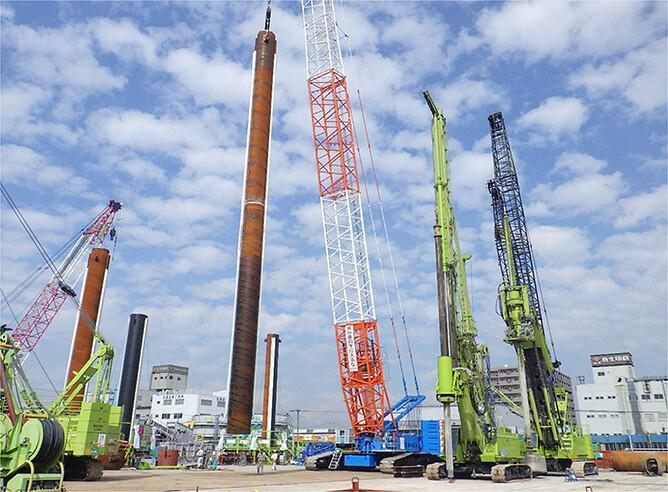
Steel pipe piles are used to transfer structural loads into deeper and more stable soil layers.
They are commonly installed in:
- Bridge foundations
- Port and harbor construction
- Marine engineering
- Industrial facilities
- Large building foundations
ASTM A252 is a widely used standard for steel pipe piles.
ERW or other welded pipe manufacturing processes may be suitable depending on the required diameter, wall thickness, grade, driving conditions, and project specifications.
For piling projects, buyers should pay particular attention to pipe straightness, end preparation, dimensional tolerances, weld quality, and the required inspection documentation.
3.3 Scaffolding and Temporary Structures
ERW steel tubes are commonly used in scaffolding systems and temporary construction structures.
Typical applications include:
- Construction scaffolding
- Temporary support frames
- Access platforms
- Formwork support systems
These products are generally selected according to the applicable regional standards and project requirements.
For scaffolding orders, outside diameter, wall thickness, length, material grade, surface condition, and corrosion protection are important purchasing considerations.
Galvanized ERW pipes may be specified where additional corrosion protection is required.
3.4 Tubular Trusses and Roof Structures
ERW round and square hollow sections are also used in tubular trusses, roof structures, and other fabricated steel assemblies.
Their relatively consistent dimensions can simplify cutting, connection preparation, and workshop fabrication.
For manufacturers producing repeated structural components, consistent pipe dimensions can help reduce fitting adjustments and material waste.
3.5 Mechanical and Industrial Equipment Structures
In industrial facilities, ERW pipes are frequently used in non-pressure-bearing structural components, including:
- Conveyor support frames
- Machinery supports
- Industrial equipment structures
- Guardrails and handrails
- Pipe support systems
The required pipe grade and dimensions depend on the load, operating environment, and applicable design specification.
Where a pipe is intended to carry internal pressure or operate at elevated temperatures, buyers should use the relevant pressure-piping standard rather than assuming that a structural pipe specification is sufficient.
4. ERW vs Seamless Steel Pipe for Structural Applications
One of the most common questions from steel pipe buyers is whether ERW pipe can replace seamless pipe.
The answer depends on the application and the specification. Both manufacturing methods have their own advantages, and neither is universally suitable for every project.
4.1 Manufacturing Differences
ERW pipe is produced by forming steel strip and joining its longitudinal edges through electric resistance or high-frequency welding.
Seamless pipe is manufactured from a solid steel billet, which is heated and pierced to create a hollow section before undergoing further rolling and sizing operations.
The main manufacturing difference is the presence of a longitudinal weld seam in ERW pipe.
This difference affects manufacturing controls, inspection requirements, and certain product characteristics, but it does not automatically determine the quality or suitability of the finished pipe.

4.2 Dimensional Accuracy
ERW pipe production uses steel strip with controlled initial thickness and a continuous forming process.
This can provide good wall thickness consistency and dimensional control.
Seamless pipe is manufactured through piercing and hot-working processes. Its wall thickness distribution can vary depending on the manufacturing process, size, and production controls.
For structural fabrication requiring consistent dimensions, ERW pipe can be an attractive option.
However, actual dimensional tolerances must be checked against the applicable product standard and purchase specification.
Seamless pipe inherits the wall eccentricity of the hot-piercing process; the standard tolerates ±12.5% on wall thickness.
ERW tube is formed from fixed-width strip, so wall variation along the length is minimal — one reason cold-formed welded HSS under ASTM A500 has been the default column material in US practice for decades, including seismic design categories.
4.3 Mechanical Properties and Weld Seam Quality
The mechanical properties of both ERW and seamless pipes depend on the steel grade, manufacturing process, heat treatment, and applicable product standard.
ERW pipes contain a longitudinal weld seam that must meet the relevant manufacturing and inspection requirements.
Modern high-frequency welding technology allows manufacturers to produce consistent weld seams under controlled production conditions.
Seamless pipes do not have a longitudinal manufacturing weld, but they still require appropriate material testing, dimensional inspection, and quality control.
For structural applications, buyers should evaluate the complete product specification rather than judging suitability solely by whether a pipe is welded or seamless.
4.4 Cost and Procurement Considerations
ERW pipes can offer a cost advantage for many standard sizes and applications because their manufacturing process is generally more efficient.
Seamless pipes may be preferred where the applicable standard, pressure requirements, temperature conditions, or project specification calls for seamless construction.
The actual price difference depends on:
- Pipe diameter and wall thickness
- Material grade
- Manufacturing availability
- Order quantity
- Testing and inspection requirements
- Surface treatment
- Delivery destination
For large-volume structural projects, evaluating both manufacturing options can help buyers identify the most suitable balance between technical requirements and procurement cost.
ERW vs Seamless Steel Pipe: Quick Comparison
| Comparison | ERW Steel Pipe | Seamless Steel Pipe |
|---|---|---|
| Manufacturing | Formed steel strip with welded seam | Pierced and rolled solid billet |
| Longitudinal weld | Yes | No |
| Wall thickness consistency | Generally good | Depends on manufacturing process |
| Dimensional control | Generally good | Depends on size and process |
| Production efficiency | Suitable for continuous production | More complex manufacturing route |
| Cost | Often economical for suitable specifications | May involve higher production costs |
| Typical applications | Structural, general service, and specified pressure applications | Structural, mechanical, and pressure applications |
The final selection should be based on the required product standard, design conditions, material properties, and inspection requirements.
5. When Should Buyers Consider LSAW or Seamless Steel Pipes?
A supplier who only tells you where their product works isn’t worth your email address.
Here is where we actively steer projects away from ERW pipes:
walls above roughly 20 mm (the practical ERW ceiling is 20–22 mm), low-temperature service requiring Charpy-qualified seamless grades such as A333, fatigue-critical members like crane booms and long-span bridge trusses, and any pressure part at creep temperatures (A106, A335 territory).
Notice what is not on this list: ordinary buildings, piling, towers, and scaffolding — that is where ERW earns its place.
When large diameters and heavy wall thicknesses are required
For large-diameter pipes with heavy wall requirements, LSAW manufacturing may be more appropriate, depending on the available production range and applicable standard.
LSAW pipes are widely used in large-scale infrastructure, industrial pipelines, and foundation engineering.
When the project specifically requires seamless construction
Some pressure and high-temperature applications specify seamless pipes.
For example, ASTM A106 is commonly used for seamless carbon steel pipe in high-temperature service, while ASTM A333 covers seamless and welded carbon and alloy steel pipe for low-temperature service.
The required grade and manufacturing method should be confirmed against the applicable specification.
When low-temperature impact requirements are critical
Projects involving low-temperature service may require specific Charpy V-notch impact properties.
The selected product must meet the specified impact test temperature and acceptance criteria. Buyers should not assume that every ERW or seamless pipe automatically satisfies these requirements.
When cyclic loading or fatigue requirements are involved
For dynamically loaded structures, the engineering design should consider material properties, weld details, connection geometry, fabrication quality, and fatigue performance.
The presence or absence of a manufacturing seam is only one part of the overall assessment.
The best approach is to provide the complete technical specification to the supplier before selecting a manufacturing method.
For heavy-wall or large-diameter structural work beyond ERW’s range, see our LSAW pipe manufacturing page — and our LSAW vs SSAW comparison if you are weighing welded processes against each other.
6. What Should Buyers Include in an ERW Steel Pipe RFQ?
A clear RFQ helps suppliers evaluate production feasibility, calculate material costs, and prepare an accurate quotation.
For structural ERW steel pipe orders, the following information should be included whenever possible.
6.1 Standard and Material Grade
Specify the applicable product standard and grade.
Examples:
- ASTM A500 Grade B or Grade C
- EN 10219 S355J2H
- ASTM A252 Grade 2 or Grade 3
- ASTM A53 Grade B
- API 5L Grade B or X52
Avoid general descriptions such as “high-quality carbon steel pipe” without identifying the required standard and grade.
Wall thickness is where ordering mistakes are most expensive. Our steel pipe schedules buying guide explains what SCH 40 and SCH 80 actually mean at the mill — and the common undertolerance trap.
6.2 Outside Diameter and Wall Thickness
Provide the exact pipe dimensions.
For example:
- Outside Diameter: 219.1 mm
- Wall Thickness: 6.35 mm
For square and rectangular hollow sections, provide both outside dimensions and wall thickness.
If the project allows dimensional alternatives, indicate the acceptable range.
6.3 Quantity and Required Length
Specify the total quantity by size and grade.
Buyers should also clarify whether they require:
- Fixed lengths, such as 6 m or 12 m
- Random lengths
- Custom cutting lengths
- Mixed-size shipments
Length requirements affect production planning, material utilization, packaging, and container loading.
6.4 Inspection and Testing Requirements
Inspection requirements should be agreed upon before production.
Depending on the product standard and project specification, these may include:
- Chemical composition analysis
- Tensile testing
- Flattening or other applicable mechanical tests
- Hydrostatic testing
- Weld seam non-destructive testing
- Dimensional inspection
- Visual inspection
- Third-party inspection
If the project requires ultrasonic testing, radiographic testing, or another specific NDT method, state the required inspection scope clearly.
For documentation, EN 10204 3.1 inspection certificates are commonly requested for industrial steel pipe orders.
Where third-party inspection or EN 10204 3.2 certification is required, the arrangements should be confirmed before production and shipment.
6.5 Surface Treatment and End Finish
Specify the required surface condition and finishing details.
Common options include:
- Black or bare finish
- Hot-dip galvanized
- Epoxy coating
- 3PE or FBE coating, where applicable
- Plain ends
- Beveled ends
- Threaded ends, where specified
The selected coating and end finish should be compatible with the intended application and project requirements.
6.6 Packaging, Delivery, and Destination
For export orders, buyers should also provide:
- Required packaging method
- Bundle marking requirements
- Shipping destination or discharge port
- Required delivery schedule
- Any special loading or documentation instructions
For distributors handling regular inventory replenishment, it is also useful to provide expected order quantities and the required mix of sizes.
The more complete the RFQ, the easier it is for the supplier to confirm specifications, production availability, and delivery arrangements.
7. Frequently Asked Questions About Structural ERW Steel Pipes
Is ERW steel pipe suitable for load-bearing structures?
Yes. ERW steel pipe can be used for load-bearing structures when it meets the applicable structural standard, material grade, dimensional tolerances, and engineering design requirements. ASTM A500 and EN 10219 are commonly specified for structural hollow sections used in columns, braces, and industrial building frames.
What is the difference between ASTM A500 and ASTM A53?
ASTM A500 covers cold-formed structural tubing, while ASTM A53 covers welded and seamless pipe for general service and pressure applications. A500 is specifically designed for structural hollow sections with relevant dimensional and mechanical requirements. A53 should not automatically replace A500 in structural designs.
Can ERW steel pipe be used for piling projects?
Yes. Welded steel pipe can be used in piling projects when it meets the applicable piling standard and project requirements. ASTM A252 covers both welded and seamless steel pipe piles in Grades 1, 2, and 3. Diameter, wall thickness, length, and inspection requirements should be confirmed before ordering.
Is ERW steel pipe cheaper than seamless steel pipe?
ERW pipe is often more economical than seamless pipe for comparable specifications because its manufacturing process is generally more efficient. However, actual prices depend on material grade, dimensions, order quantity, inspection requirements, and market conditions.
What inspection is required for structural ERW steel pipes?
Inspection depends on the applicable product standard and project specification. It may include chemical analysis, tensile testing, dimensional checks, hydrostatic testing where required, and weld seam NDT. Buyers should specify the inspection scope and required inspection certificates in the purchase order.
Can ERW steel pipe be galvanized?
Yes. ERW steel pipes can be supplied with hot-dip galvanized coatings when the pipe dimensions, material, and intended application are suitable for the process. Buyers should specify the required coating standard or zinc coating thickness and any additional surface requirements.
What information is needed to obtain an ERW steel pipe quotation?
A complete RFQ should include the product standard, grade, outside diameter, wall thickness, quantity, required length, inspection requirements, surface treatment, and destination port. Drawings or project specifications are also helpful when ordering non-standard structural sections.
8. Source ERW Steel Pipes for Your Industrial Projects
Choosing the right ERW steel pipe involves more than comparing prices and dimensions. The material grade, manufacturing standard, dimensional tolerances, weld inspection, and intended application all affect the suitability of the finished product.
JS Steel Pipes, operated by Hebei Jinsheng Pipe Fitting Manufacturing Co., Ltd., has been engaged in steel pipe manufacturing and export since 1983.
Based in Cangzhou, Hebei, China, the company supplies industrial carbon steel pipes for distributors, trading companies, engineering contractors, and infrastructure projects.
For ERW steel pipe enquiries, buyers can provide their required standards, grades, dimensions, quantities, and inspection specifications for technical and commercial evaluation.
Whether you are sourcing ERW pipe for industrial construction, mechanical structures, or general engineering applications, our team can help review your requirements and confirm suitable product options.

Contact JS Steel Pipes for an ERW Steel Pipe Quotation
- Website: https://jssteelpipes.com/
- Email: info@jssteelpipes.com
- WhatsApp: +86 180 0311 9682
Send us your pipe specifications or project drawings to discuss product availability, inspection requirements, and delivery arrangements.