In the world of industrial piping, wall thickness is not just a dimension—it is a critical parameter that dictates the pipe’s pressure-bearing capacity, structural load-bearing, and overall longevity.
At JS FITTINGS, we frequently receive inquiries regarding the minimum wall thickness for Electric Resistance Welded (ERW) pipes. For project managers, engineers, and distributors, selecting the right thickness is the first step in ensuring safety and cost-effectiveness. In this article, we explore the standards, calculations, and factors that define the minimum wall thickness for ERW pipes.
1. What Determines the Minimum Wall Thickness?
The “minimum” wall thickness is not a single, universal number. Instead, it is governed by a combination of international standards (such as ASTM, API, and EN) and the specific demands of your application. The following factors are primary:
- Operating Pressure: The internal pressure the pipe will carry determines the required thickness to prevent bursting or deformation.
- Corrosion Allowance: For pipes used in oil, gas, or corrosive environments, an “extra” thickness is added to the minimum requirement to compensate for material loss over time.
- Mechanical Load: If the pipe is used for structural purposes (e.g., piling or construction), it must withstand external crushing loads, bending, and vibration.
- Fabrication Methods: The welding process and post-weld heat treatment must be compatible with the thickness to maintain weld integrity.
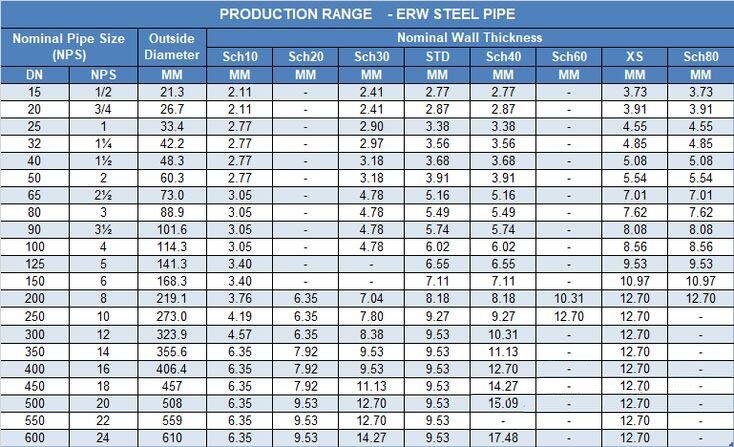
2. Adherence to International Standards
When sourcing ERW pipes, your specifications should always align with established standards. These standards define the allowable tolerance for wall thickness.
- API 5L: Primarily used in the oil and gas industry. It specifies strict wall thickness tolerances, usually allowing for a variation of -12.5% from the nominal thickness, depending on the specific grade and diameter.
- ASTM A53 / A135: Common standards for structural and pressure-rated steel pipes. They provide tables that dictate the “nominal” wall thickness, from which the minimum is derived after accounting for manufacturing tolerances.
Pro-tip: Always specify if your project requires a “Minimum Wall” or “Nominal Wall” specification. Ordering based on “Minimum Wall” ensures that the pipe will never be thinner than your calculated design requirement.
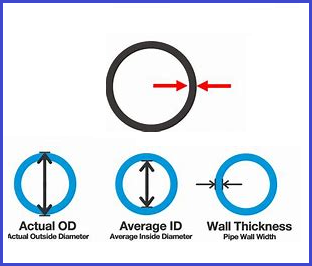
3. Why You Must Avoid “Under-Thickness”
Choosing a pipe thinner than what is required for your project can lead to:
- Reduced Pressure Rating: The pipe may fail during hydrostatic testing or actual operation.
- Welding Difficulties: Extremely thin walls can be challenging to weld in the field, increasing the risk of weak joints.
- Regulatory Non-Compliance: Many industrial projects require third-party inspection (TPI). If your pipes do not meet the minimum wall thickness prescribed by the design engineer, the batch will be rejected, leading to costly project delays.
4. How JS FITTINGS Ensures Precision
At JS FITTINGS, we utilize high-precision ultrasonic thickness gauges during the production process. We monitor the steel strip thickness before welding and verify the final wall thickness of the finished pipe. This ensures that every pipe we supply meets the specified tolerance requirements of your project.
Whether your application requires standard Schedule 40 or custom thin-wall ERW pipes, our team ensures that manufacturing tolerances are strictly maintained within the limits defined by the requested ASTM or API standards.
Final Advice for Buyers
When requesting a quote, please provide the following details to ensure we offer the most accurate wall thickness for your needs:
- Application: (e.g., Oil transportation, structural piling, water supply)
- Pressure Requirements: (e.g., PSI or Bar)
- Standard/Grade: (e.g., API 5L X52, ASTM A53 Grade B)
- Tolerance Requirements: (e.g., Are you working with a strict minimum thickness requirement?)
Need help calculating the right specifications for your next project?
Our technical team at JS FITTINGS is ready to assist.
Explore our full range of ERW Pipe products or Contact our experts today for a tailored solution.
Email: info@jssteelpipes.com
WhatsApp: +8618003119682
Frequently Asked Questions (FAQ)
Q: Can JS FITTINGS produce ERW pipes with custom wall thicknesses?
A: Yes. While we maintain a wide inventory of standard schedules (such as Sch 10, 20, 40, and 80), we specialize in manufacturing custom wall thicknesses to meet specific engineering requirements or project-specific specifications. Please provide your technical design documents, and our engineering team will assess the feasibility.
Q: What is the difference between “Nominal Wall” and “Minimum Wall” thickness?
A: “Nominal” refers to the standard thickness defined by a pipe schedule, which includes an allowable manufacturing tolerance. “Minimum” wall thickness means that the pipe is manufactured to ensure that the wall is never thinner than the specified value. If your project has critical pressure requirements, we strongly recommend specifying “Minimum Wall” in your inquiry.
Q: How does JS FITTINGS verify wall thickness during production?
A: We employ a multi-stage inspection process. This includes incoming material gauge checks, continuous online ultrasonic monitoring during the pipe-forming process, and final dimensional verification by our QC team using high-precision digital micrometers and ultrasonic sensors.
Q: Which international standards do your ERW pipes comply with?
A: Our ERW pipes are manufactured in strict accordance with international standards, including ASTM A53, ASTM A135, API 5L, and EN 10219/10210. We provide full Mill Test Certificates (MTC) with every shipment to guarantee material traceability and compliance.
Q: Can you provide pipes for high-pressure oil and gas applications?
A: Absolutely. We have extensive experience supplying API 5L grade ERW pipes for the oil and gas industry. These pipes undergo rigorous non-destructive testing (NDT), including hydrostatic testing and ultrasonic weld seam inspection, to ensure they perform safely under high-pressure conditions.