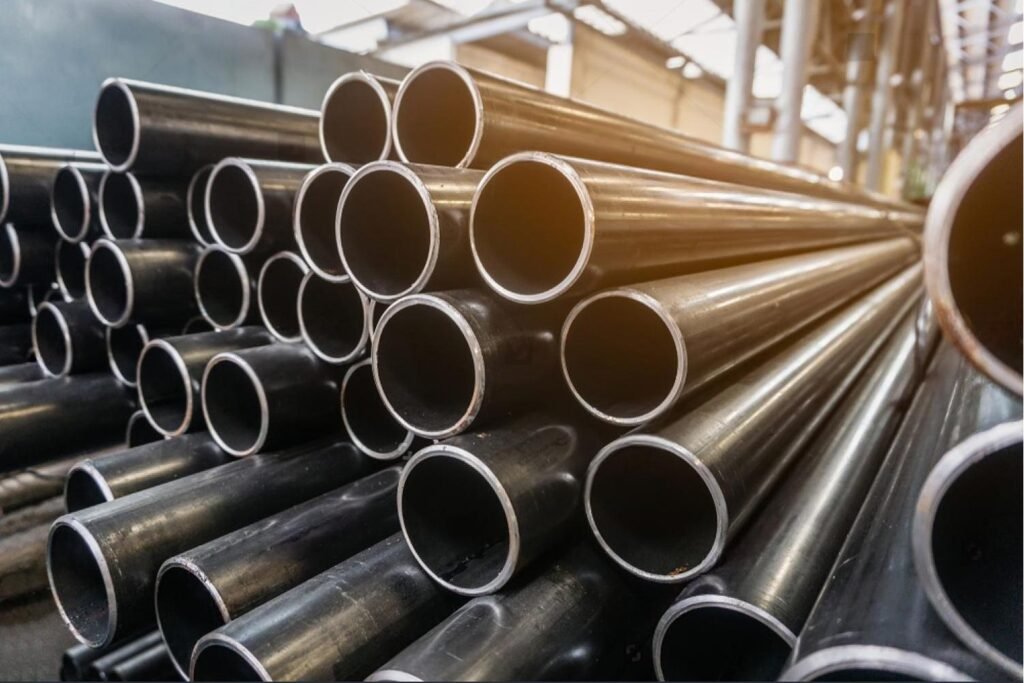
Electric Resistance Welded (ERW) carbon steel pipes are produced by cold-forming steel strip into a tubular shape and welding the longitudinal seam using high-frequency electric current (HFW). Designed to meet demanding structural and fluid transport requirements, ERW carbon steel pipes offer tight dimensional tolerances, uniform wall thickness, and reliable joint integrity without adding filler metal.
Common Structural & Line Pipe Specifications (ASTM A53 / API 5L)
Below is a standard dimensional reference chart for high-frequency ERW line pipes commonly produced and stocked for industrial projects.
| NPS (Inches) | Outer Diameter (mm) | Schedule / Wall Class | Wall Thickness (mm) | Nominal Weight (kg/m) | Primary Standards |
|---|---|---|---|---|---|
| 2″ | 60.3 mm | SCH 40 / STD | 3.91 mm | 5.44 kg/m | ASTM A53 Gr. B / API 5L Gr. B |
| 4″ | 114.3 mm | SCH 40 / STD | 6.02 mm | 16.07 kg/m | ASTM A53 / API 5L PSL1 |
| 6″ | 168.3 mm | SCH 80 / XS | 10.97 mm | 42.56 kg/m | API 5L X42 / X52 PSL2 |
| 8″ | 219.1 mm | SCH 40 / STD | 8.18 mm | 42.55 kg/m | API 5L / ASTM A252 Gr. 3 |
| 12″ | 323.8 mm | SCH 40 / STD | 9.53 mm | 73.81 kg/m | API 5L X60 / X65 PSL2 |
Engineering Selection: ERW Pipe vs. Seamless (SMLS) Pipe
Selecting between High-Frequency ERW and Seamless steel pipe depends on working pressure, structural load, and budget parameters. Modern HFW process lines perform full-seam online ultrasonic testing and inline seam annealing, ensuring joint efficiency equal to the base metal.
| Evaluation Criteria | High-Frequency ERW Pipe | Seamless (SMLS) Pipe |
|---|---|---|
| Wall Thickness Tolerance | Strict precision (±5% variance across strip) | Moderate variance due to hot perforation |
| Surface Finish & Uniformity | Smooth internal and external finish | Rougher surface scale from hot rolling |
| Production Lead Time | Fast rollout for mid-to-large tonnages | Longer mill setup and piercing cycle |
| Cost Efficiency | 15% to 30% lower than SMLS in equivalent ODs | Higher raw material and operational costs |
| Pressure Thresholds | Ideal for low, medium, and line-pipe pressures | Preferred for ultra-high pressure boiler applications |
ERW vs. LSAW vs. Seamless: Which Engineering Choice is Right?
The core difference lies in the forming method and the weld seam’s nature. While ERW pipe is formed from continuous steel coils, LSAW pipe (Longitudinal Submerged Arc Welded) is produced from heavy steel plates, allowing for much thicker walls.
| Feature | ERW (Electric Resistance) | LSAW (JCOE/UOE) | Seamless (SMLS) |
|---|---|---|---|
| OD Range | 1/2″ – 24″ | 16″ – 60″ | 1/8″ – 28″ |
| Wall Thickness | Up to 15.9mm | Up to 50mm+ | Up to 80mm+ |
| Weld Seam | One Longitudinal (Induction) | One Longitudinal (Submerged Arc) | None (N/A) |
| Best Use Case | Mid-pressure gas/water, Piling | Heavy-duty offshore, High-pressure gas | Extreme heat/Critical pressure lines |
| Cost Ranking | Economic / Budget-friendly | Mid-range | Premium |
Technical Standards & Material Grades for Global Projects
We supply ERW pipes that comply strictly with international quality protocols. For most infrastructure projects, the following standards are critical:
- API 5L (PSL1 & PSL2): The gold standard for line pipe (Grades B, X42, X52, X60, X65).
- ASTM A53: Standard for steam, water, and air pipelines.
- ASTM A252: Preferred for structural piling applications.
- EN 10219: Cold-formed welded structural hollow sections.
Mill Capabilities & Quality Control Protocol at JS FITTINGS
To eliminate structural defects in long-distance pipelines and foundation piling, JS FITTINGS enforces a strictly audited quality assurance workflow for every production run:
100% NDT Seam Inspection
Every meter of the weld seam passes through online Ultrasonic Testing (UT) and Eddy Current inspection to detect internal voids or fusion defects.
Inline Weld Annealing
Post-weld induction heat treatment normalizes the Heat Affected Zone (HAZ) to restore grain structure balance and eliminate stress cracking risk.
Hydrostatic Testing & MTC
Pipes are hydro-tested up to required API standards. Mill Test Certificates (EN 10204 3.1) accompanying shipments detail chemical compositions and mechanical properties.
Custom Processing & Coatings
Off-the-shelf and custom-cut lengths available with 3LPE, 3LPP, FBE, black paint, or galvanized finishes, alongside precise end-beveling for field welding.
Frequently Asked Questions
Q: What is the main structural difference between API 5L PSL1 and PSL2 ERW pipes?
A: PSL2 introduces mandatory requirements for fracture toughness (Charpy V-Notch testing), maximum carbon equivalents, and stricter non-destructive testing, whereas PSL1 serves standard pipeline pressure conditions without mandatory impact testing.
Q: What surface protection coatings can JS FITTINGS apply to carbon steel ERW pipes?
A: We provide internal and external Anti-Corrosion options including Fusion Bonded Epoxy (FBE), 3-Layer Polyethylene (3LPE), 3-Layer Polypropylene (3LPP), anti-rust black varnish, and hot-dip galvanizing per project specifications.
Q: Can ERW pipe be specified for deep pile foundations (ASTM A252)?
A: Yes. ASTM A252 Grade 2 and Grade 3 ERW carbon steel pipes offer exceptional axial load resistance and uniform wall thickness, making them widely used for bridge piers, building foundations, and marine dock structures.
Q: What is the standard minimum order quantity (MOQ) and delivery timeline?
A: Standard stocking sizes (2″ to 12″ OD) have no strict MOQ and can ship within 7–10 days. Custom wall thicknesses, specific material grades, or custom coatings typically run on a 20 to 30-day mill schedule.
Request Technical Data Sheets or a Fast Mill Quote
Contact JS FITTINGS’ technical sales team directly to verify stock availability, request an MTC sample, or receive competitive FOB/CIF/EXW pricing within 2 hours.
Send Inquiry To Emails: info@jssteelpipes.com