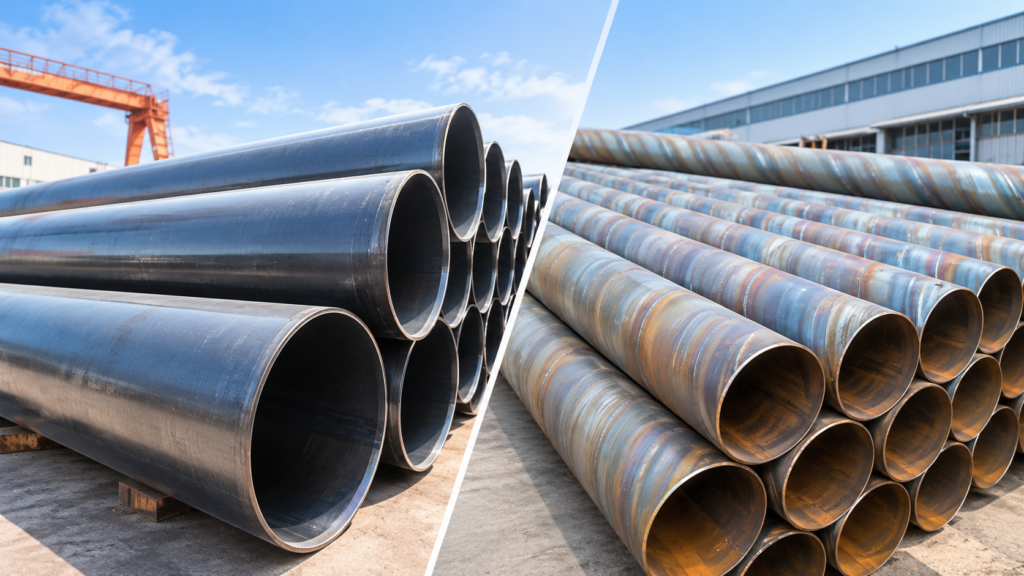
If you read only one paragraph, use LSAW steel pipes for high-pressure oil and gas trunk lines, offshore and sour-service work, and any segment where strict specifications will be scrutinised. Use SSAW steel pipes for low-to-moderate-pressure water, sewage, and slurry lines; dredging and piling; and large-diameter jobs where budget matters more than a short weld.
For the same diameter and wall, SSAW pipes typically come in 10–25% cheaper per ton.
LSAW pipe produced through UOE or JCOE forming, particularly when followed by mechanical expansion, can achieve good dimensional accuracy and controlled roundness. Actual residual stress and dimensional tolerances depend on the forming process, expansion procedure, material properties and manufacturing quality control.
In practice, the specification usually decides for you — this guide explains why, so you can quote it accurately and avoid paying for a process you do not need.
LSAW (Longitudinal Submerged Arc Welded) and SSAW (Spiral Submerged Arc Welded, also sold as HSAW) are the two workhorses of large-diameter welded pipe. Both use submerged arc welding. Both can be supplied to API 5L. The difference starts with the raw material, and almost every performance gap follows from it.
The short answer: which one fits your job
| Choose LSAW pipes when… | Choose SSAW pipes when… |
| Design pressure is high, or cycles (start/stop, surge) | Low to moderate, steady pressure |
| Gas transmission, offshore, sour (H₂S) service | Water, sewage, irrigation, slurry, dredging |
| Wall above ~25 mm | Wall within 6–24 mm |
| Tight ovality / fit-up tolerance for field welding | Large OD where LSAW tooling is scarce or slow |
| Full-length NDT and traceability are contractual | Cost and delivery speed drive the decision |
LSAW vs SSAW at a glance
| Feature | LSAW Pipe | SSAW (HSAW) Pipe |
| Weld seam | Straight, parallel to axis | Helical, at an oblique forming angle |
| Raw material | Single heavy plate per pipe | Continuous hot-rolled coil / strip |
| Forming | UOE / JCOE / press bending, one pipe at a time | Continuous spiral forming, cut to length |
| Weld length | One 12 m seam on a 12 m pipe | ~1.5–3 m of weld per metre of pipe |
| Diameter range | Typically 16″–60″ (406–1,570 mm) | Typically 8″–120″ (219–3,120 mm) |
| Wall thickness | 8–40 mm standard; heavier on request | 6–24 mm; ~25 mm is the practical ceiling |
| Residual stress | Lower, especially after mechanical expansion | Higher; forming + welding stress combine |
| Heat-affected zone | Smaller and more uniform | Larger, follows the spiral path |
| Dimensional accuracy | High; expansion improves roundness | Lower; ovality typically ~1.0% OD |
| NDT coverage | Single straight seam, easy to scan | Long oblique seam, more inspection work |
| Production speed | Slower, higher cost | Faster, continuous, lower cost |
| Typical length | 12 m, sometimes 18 m | 12–30 m, cut to order |
Why the plate-versus-coil decision drives everything
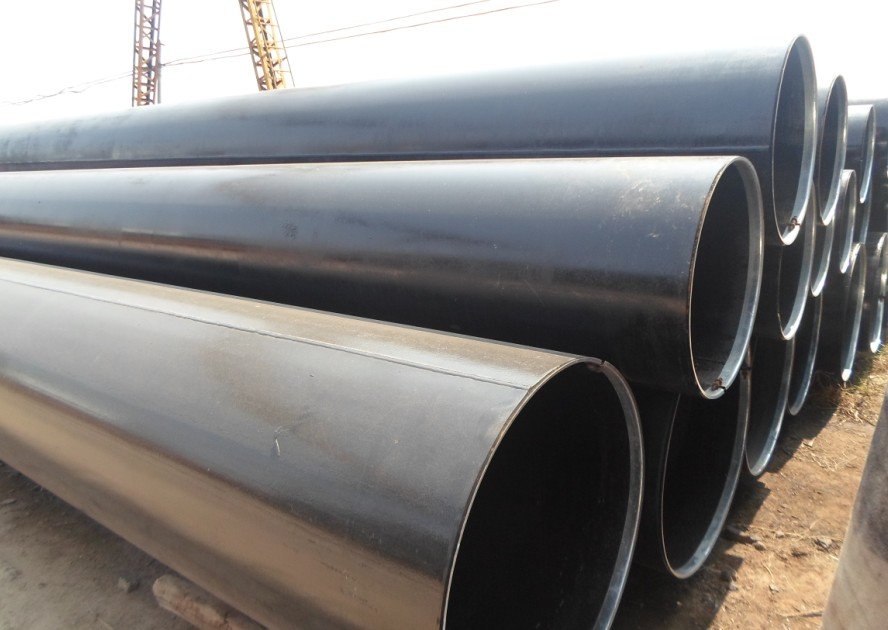
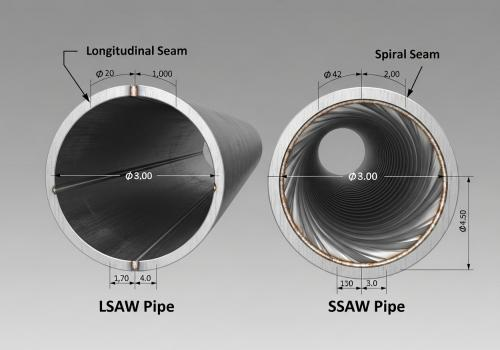
An LSAW pipe starts as one plate. It is formed into a cylinder, the longitudinal seam is welded inside and out, and on UOE and JCOE lines the pipe then goes through mechanical expansion — usually 1.0–1.5% — which rounds the pipe and relaxes forming stress. You get one predictable seam, a short heat-affected zone and a round pipe that lines up cleanly in the field.
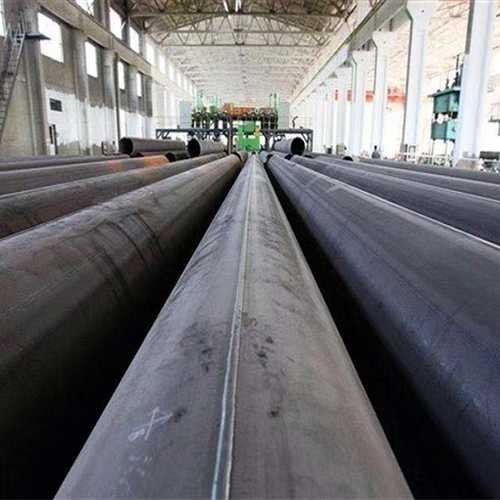
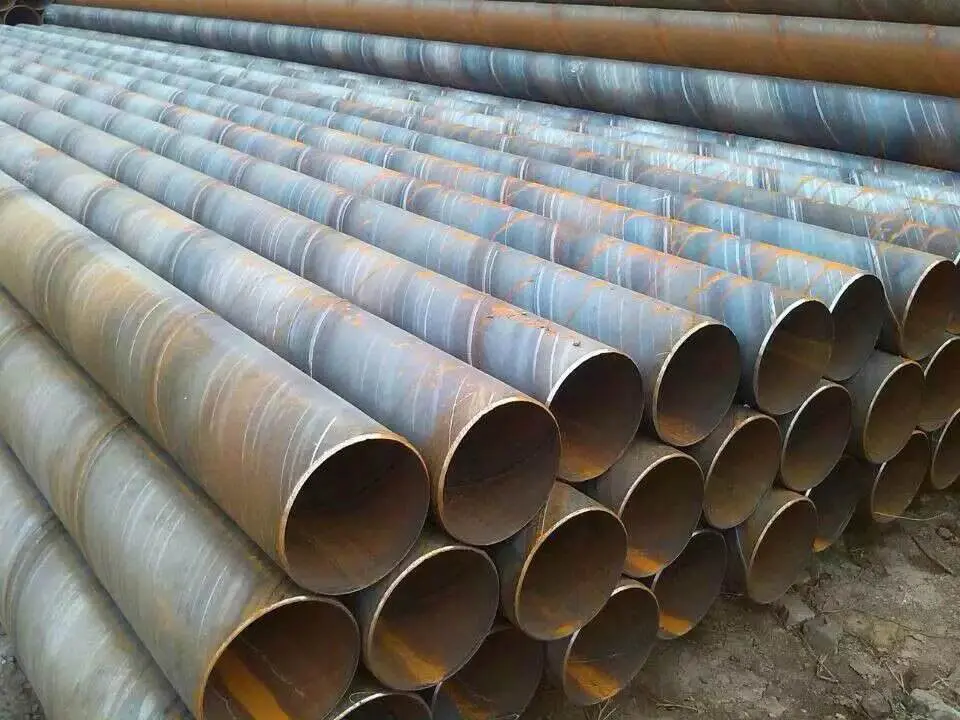
An SSAW pipe starts as a coil. The strip is fed continuously into a forming angle and welded along a helix. Change the strip width or the forming angle and you change the diameter without changing tooling — that is why SSAW can reach diameters a plate mill cannot, and why it is quick to produce. The trade-off is a weld that runs 18–36 m on a 12 m pipe, plus forming stresses that stay in the body of the pipe because most SSAW lines do not expand.
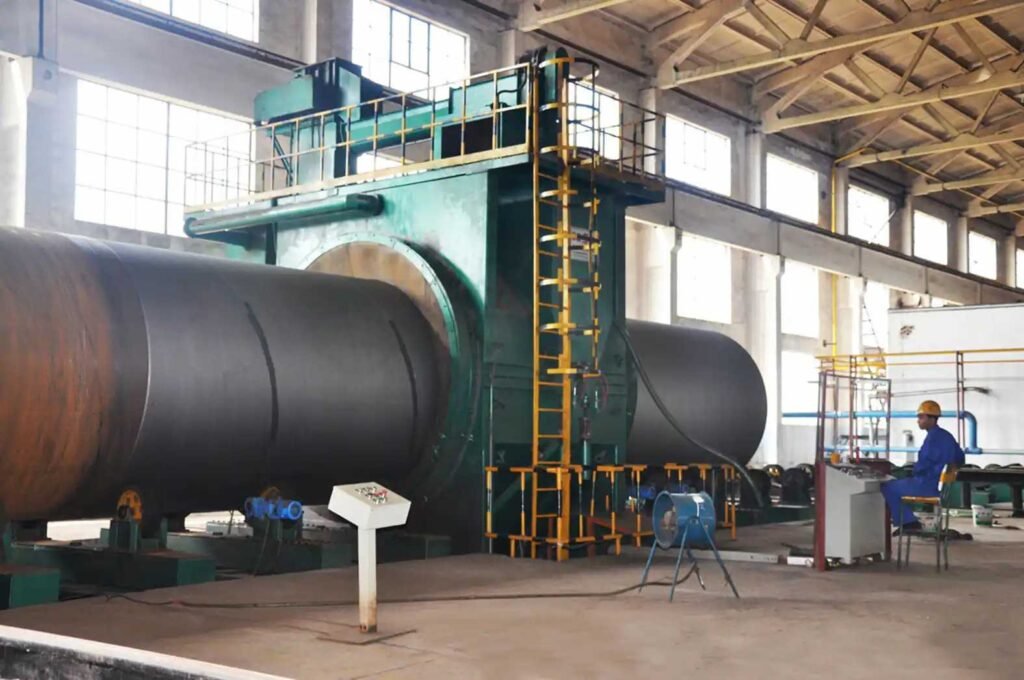
For a buyer, this is not academic. A shorter weld means fewer places for a defect to hide, less UT/RT to pay for and a simpler weld map to hand over. That is the main reason transmission operators specify LSAW for critical sections even when SSAW is technically permitted.
Where the choice actually gets made
Oil and gas transmission. High-pressure gas trunk lines, compressor stations and high-consequence areas go to LSAW or seamless steel pipes. SSAW is common in lower-pressure gathering lines, water injection and non-critical sections, and plenty of long-distance gas lines use a mix: SSAW for the plain open ground, LSAW at river crossings, roads, fault zones and tunnels. If your route includes horizontal directional drilling, plan on LSAW — the pipe sees bending and tensile load that a spiral seam handles poorly.
Water, sewage and slurry. This is SSAW territory. Diameters are large, pressures are modest and the budget is usually public. Liquid transmission lines are commonly coated to AWWA C210 (internal epoxy) or wrapped/lined externally; see our 3PE vs FBE guide for coating selection.
Piling and structures. SSAW to ASTM A252 is the standard choice for king piles, sheet-pile accompaniment and marine foundations. The larger diameter and lower cost per metre win. For concentrated structural loads where wall thickness above 25 mm is required, LSAW or seamless takes over.
Sour service and offshore. Do not assume two pipes with the same API 5L grade behave the same in H₂S. Sour service calls for NACE MR0175 / ISO 15156 compliance, hardness control and confirmed SSC testing. Offshore pipelines designed to DNV-ST-F101 will often restrict or exclude spiral pipe. Get the project specification in writing before you quote.
Cost and lead time
For the same OD, wall, grade and coating, SSAW pipes normally saves 10–25% per ton. The coil is cheaper than heavy plate, production is continuous, and one coil width can produce several diameters. LSAW requires a plate for every pipe and, for a new diameter, a forming setup — which is why small-quantity LSAW orders attract tooling charges and longer lead times.
The saving is not always real, though. Compare quotes on delivered, inspected pipe:
- SSAW’s longer weld means more NDT hours and more weld repairs if the mill’s process is unstable.
- Higher ovality can slow field fit-up and increase welding time on site.
- A 30 m SSAW pipe can reduce the number of field girth welds versus 12 m LSAW — worth pricing on a long route.
On a 20 km line the field-weld saving can offset part of the pipe price difference. Ask your supplier for both a per-ton price and a per-metre-installed estimate.
The RFQ checklist buyers should send
A vague inquiry gets a vague price. Include all of the following and you will get a comparable quotation:
- Standard and edition. API 5L PSL1 or PSL2, and which edition.
- Grade and chemistry. e.g. API 5L Gr. B PSL2 or X70 PSL2; carbon equivalent limits; any supplemental requirement such as S1 (sour service) or S4.
- Dimensions. OD, wall, length (DRL 11.8 m / 12 m / 20 m), and ovality tolerance.
- Process. LSAW (UOE/JCOE) or SSAW — name it, do not leave it to the supplier’s discretion.
- Inspection scope. 100% UT of the weld, RT percentage, Charpy test temperature and minimum absorbed energy, hydrotest pressure, and whether an EN 10204 3.1 or 3.2 MTC is required.
- End preparation and coating. Bevel angle, root face, cutback length, and FBE / 3PE / 3LPP specification.
- Third-party inspection. SGS, BV or TÜV, and whether it is at the mill or before shipment.
Five mistakes that cost buyers money
Specifying LSAW for a job that does not need it. Correct spec beats prestige. A 48″ water line does not gain anything from a JCOE pipe that a spiral pipe cannot deliver.
Assuming SSAW cannot carry hydrocarbons. It can, in the right pressure range and location class. The blanket ban is a project rule, not a universal code requirement.
Ordering SSAW above 25 mm wall. That is the practical forming limit. Anything thicker should be quoted as LSAW or seamless.
Comparing mill certificates without checking the NDE scope. Two quotes marked “API 5L PSL2” are not comparable if one includes 100% UT and the other does not.
Leaving the standard edition open. On a 2026 order, “API 5L” without an edition is an invitation to a dispute at delivery.
Frequently asked questions
Is SSAW the same as HSAW?
Yes. HSAW (Helical Submerged Arc Welded) and SSAW (Spiral Submerged Arc Welded) describe the same product. Some markets also use “spiral welded pipe”. LSAW is sometimes called DSAW (Double Submerged Arc Welded) because the seam is welded from both sides, though DSAW technically describes the welding method rather than the seam direction.
Which is stronger, LSAW or SSAW pipes?
At the same grade and wall, the base-metal yield and tensile strength are the same — both are made to the same API 5L grade. The difference is in the weld: LSAW has a shorter seam, lower residual stress and more uniform properties, which is why it is preferred for cyclic pressure, low temperature and critical service.
Is LSAW more expensive than SSAW?
For the same size and grade, LSAW generally runs 10–25% higher per ton, and more if new forming tooling is required. SSAW is cheaper because coil costs less than heavy plate and the process runs continuously. Note that a delivered-and-installed comparison can narrow that gap: a 30 m SSAW pipe needs fewer field girth welds than a 12 m LSAW pipe.
Can SSAW pipe be used for oil and gas?
Yes, for gathering lines, water injection and lower-pressure or low-consequence sections, subject to the operator’s specification. High-pressure gas trunk lines, offshore and sour service normally call for LSAW or seamless.
What is the maximum wall thickness for SSAW?
Around 25 mm (25.4 mm / 1 inch) on standard spiral forming equipment. Above that, quote LSAW.
Which has better dimensional accuracy?
LSAW. Mechanical expansion brings ovality down to roughly 0.6% OD or better, versus about 1.0% OD for typical SSAW. This matters for field fit-up and automatic welding.
Can LSAW and SSAW pipes be supplied to the same API 5L grade?
Yes. Both LSAW and SSAW pipes can be manufactured to applicable API 5L grades, depending on the manufacturer’s qualified production capabilities and project requirements. Buyers should confirm PSL level, grade, dimensions, testing scope and applicable edition before ordering.
Which pipe is better for large-diameter water transmission projects?
SSAW is often a cost-effective choice for large-diameter water transmission projects because of its flexible diameter range and continuous production process. However, final selection should consider design pressure, wall thickness, coating requirements, dimensional tolerances and project specifications.
What inspection documents should I request when purchasing LSAW or SSAW pipes?
Buyers should request the EN 10204 3.1 or 3.2 material test certificate, chemical and mechanical test results, hydrostatic test records, weld NDT reports and dimensional inspection records. Additional third-party inspection documents may be required by the project specification.
Working with JS FITTINGS
Hebei Jinsheng (JS FITTINGS) has supplied carbon steel pipe for more than 40 years, with API, CE and ISO certification and third-party inspection available on request.
Our supply capabilities include:
- LSAW: 406–1,570 mm OD, 8–40 mm wall — product details
- SSAW: 219–3,120 mm OD, 6–24 mm wall — product details
- Standards: API 5L PSL1/PSL2 Gr. B–X70, ASTM A53, ASTM A252, EN 10217 / EN 10219
- Coating: FBE, 3PE, 3LPP and internal liquid epoxy through our coated pipe line
- Documentation: EN 10204 3.1/3.2 MTC, WPS/PQR, NDT and hydrotest records, SGS/BV/TÜV inspection
Send your OD, wall, grade, length, standard edition and inspection scope to info@jssteelpipes.com or WhatsApp +86 180 0311 9682 for a like-for-like quote on both processes.
Related reading: ASTM A106 Grade B Pipe Specification · ERW Steel Pipe for Structural Applications · 3PE vs FBE Coating Guide
Send us your pipe diameter, wall thickness, steel grade, quantity and project specifications. We can review your requirements and provide a quotation for LSAW or SSAW steel pipes.