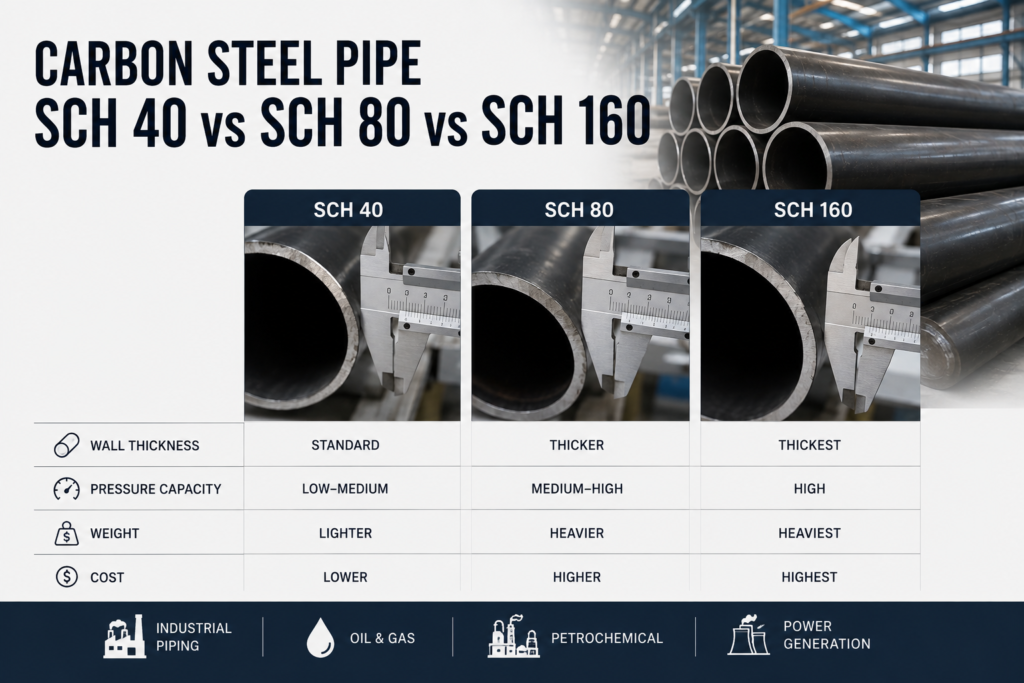
When purchasing carbon steel pipe for industrial piping, oil and gas, petrochemical, power generation, or infrastructure projects, one of the first specifications to confirm is the pipe schedule.
SCH 40, SCH 80, and SCH 160 are widely used steel pipe schedules. They define the wall thickness of a pipe for a given NPS (Nominal Pipe Size). For the same NPS, a higher schedule generally means a thicker wall, smaller inside diameter, greater weight, and higher material cost.
But choosing a pipe schedule is not simply a matter of selecting the “thicker” option.
For distributors, stockists, EPC contractors, and project buyers, the right choice depends on pressure, temperature, corrosion allowance, material grade, operating conditions, and project specifications.
This guide explains the key differences between SCH 40, SCH 80, and SCH 160 steel pipes and what buyers should check before placing an order.
What Does SCH 40, SCH 80 and SCH 160 Mean?
“Schedule” or “SCH” is a designation used to specify steel pipe wall thickness.
For a given NPS, the outside diameter generally remains fixed while the wall thickness changes with the schedule.
For example, according to ASME B36.10M, a 4-inch steel pipe has an outside diameter of approximately 114.3 mm:
| Pipe Size | SCH 40 | SCH 80 | SCH 160 |
|---|---|---|---|
| NPS 2″ | 3.91 mm | 5.54 mm | 8.74 mm |
| NPS 3″ | 5.49 mm | 7.62 mm | 11.13 mm |
| NPS 4″ | 6.02 mm | 8.56 mm | 13.49 mm |
| NPS 6″ | 7.11 mm | 10.97 mm | 18.26 mm |
| NPS 8″ | 8.18 mm | 12.70 mm | 23.01 mm |
| NPS 10″ | 9.27 mm | 15.09 mm | 25.40 mm |
| NPS 12″ | 9.53 mm | 17.48 mm | 28.58 mm |
The actual dimensions depend on the NPS and applicable standard. ASME B36.10M covers dimensions for welded and seamless wrought steel pipe, including wall thickness and outside diameter.
The basic rule is simple:
Higher SCH → thicker wall → smaller ID → higher weight → generally higher pressure capability.
However, pipe schedule itself is not a pressure rating. The allowable pressure must be determined based on material grade, temperature, design code, corrosion allowance, dimensions, and other project conditions.
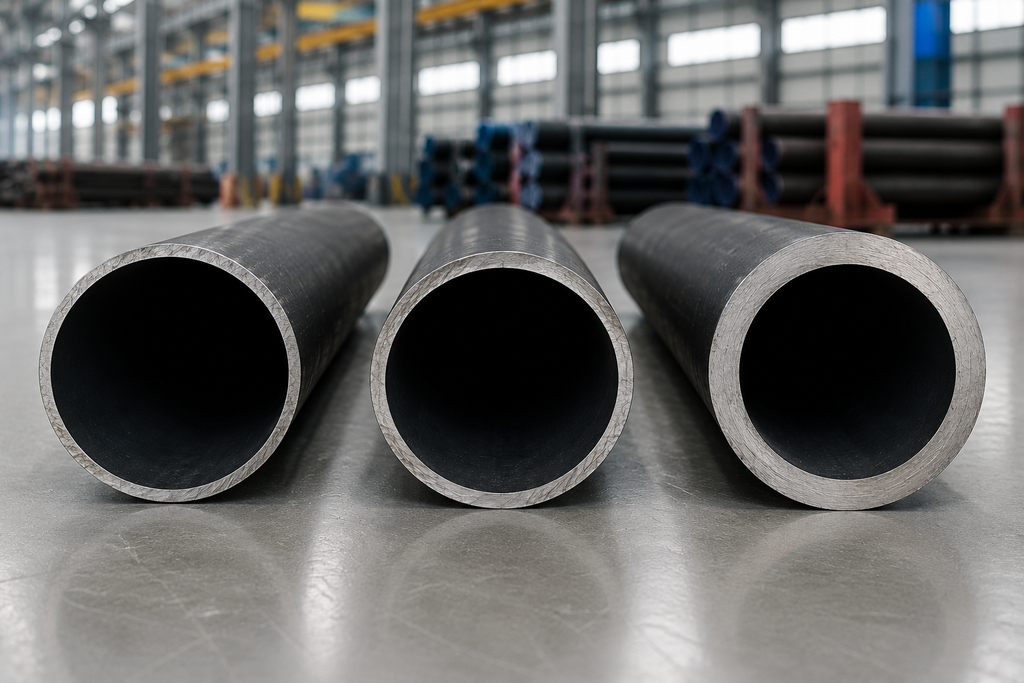
SCH 40 Steel Pipe
SCH 40 steel pipe is one of the most commonly stocked and specified pipe schedules in general industrial applications.
It offers a practical balance between wall thickness, weight, cost, and flow capacity.
Typical applications include:
- General industrial piping
- Water and utility lines
- Air and gas piping
- Low-to-moderate pressure services
- Process piping
- Structural and fabrication applications
- Oil and gas auxiliary piping
For distributors and stockists, SCH 40 is often an important inventory item because it covers a broad range of standard industrial applications.
Common material specifications may include ASTM A53, ASTM A106, and API 5L, depending on the application and project requirements.
SCH 80 Steel Pipe
SCH 80 steel pipe has a substantially thicker wall than SCH 40 for the same NPS.
The additional wall thickness provides greater resistance to internal pressure, external loads, mechanical damage, and corrosion allowance where specified.
SCH 80 is commonly considered for:
- Oil and gas piping
- Petrochemical plants
- Refineries
- Chemical processing
- High-pressure utility lines
- Steam and process piping
- Industrial piping requiring heavier wall thickness
For example, a NPS 6 SCH 40 pipe has a nominal wall thickness of about 7.11 mm, while NPS 6 SCH 80 is about 10.97 mm under ASME B36.10M.
For project procurement, however, buyers should not select SCH 80 simply because the service is described as “high pressure.” The required wall thickness should come from the applicable design calculation and project specification.
SCH 160 Steel Pipe
SCH 160 steel pipe is a heavy-wall pipe used where demanding service conditions require significantly greater wall thickness.
It is commonly found in selected:
- High-pressure oil and gas systems
- Refinery and petrochemical facilities
- High-pressure process lines
- Power generation systems
- Critical industrial piping
- High-pressure hydraulic or utility systems
SCH 160 is heavier and more expensive than SCH 40 and SCH 80. It also provides a smaller internal diameter for the same nominal pipe size.
For example, NPS 6 SCH 160 has a wall thickness of approximately 18.26 mm, compared with 7.11 mm for SCH 40.
Because of its higher material consumption and weight, SCH 160 should be specified when the engineering requirements justify it rather than simply using it as a “safer” alternative.
SCH 40 vs SCH 80 vs SCH 160: Which One Should You Buy?
There is no universal answer.
The correct schedule should be determined by the actual service conditions and project requirements.
Choose SCH 40 when:
- Standard industrial service is required
- Pressure and temperature are moderate
- Lower weight and cost are important
- Large quantities are required for stock or distribution
Choose SCH 80 when:
- Higher wall thickness is required
- Operating pressure is higher
- Additional mechanical protection is needed
- The project specification calls for XS/SCH 80
- The application involves demanding industrial service
Choose SCH 160 when:
- Very heavy wall construction is required
- The piping system operates under demanding pressure conditions
- Engineering calculations specify a heavy-wall pipe
- The project requires SCH 160 for critical service
Important: Pipe schedule should never be selected based on pressure alone. Material grade, design temperature, corrosion allowance, manufacturing method, code requirements, and allowable stress must also be considered.
SCH 40, SCH 80 and SCH 160 for Oil & Gas Projects
For oil and gas projects, pipe selection usually involves more than NPS and schedule.
A typical purchase specification may include:
NPS + Schedule + Material Grade + Manufacturing Method + Standard + PSL/Class + Length + Testing
For example:
NPS 6″ × SCH 80 × API 5L Grade X52 × PSL2 × Seamless Steel Pipe
or:
NPS 4″ × SCH 40 × ASTM A106 Grade B × Seamless × ASME B36.10M
The exact specification depends on the project.
For API 5L pipeline applications, buyers should also confirm the required PSL (Product Specification Level), grade, delivery condition, testing requirements, and any additional project specifications.
This is particularly important for EPC projects and large Oil & Gas purchases, where a dimensionally correct pipe may still be rejected if the material or testing documentation does not meet the project specification.
What Should Distributors Check Before Buying Steel Pipe?
For overseas steel pipe distributors, stockists, traders, and project suppliers, confirming the complete specification before quotation can prevent costly mistakes.
1. Standard
Confirm whether the project requires:
- ASTM A53
- ASTM A106
- API 5L
- ASME B36.10M
- Other project-specific standards
Do not assume that different standards are automatically interchangeable.
2. Pipe Size
Confirm:
- NPS
- DN
- Outside Diameter
- Wall Thickness
- Schedule
3. Material Grade
Typical grades may include:
- ASTM A53 Grade B
- ASTM A106 Grade B
- API 5L Grade B
- API 5L X42
- API 5L X52
- API 5L X60
- API 5L X65
The required grade depends on the application and project specification.
4. Manufacturing Method
Confirm whether the buyer requires:
- Seamless steel pipe
- ERW steel pipe
- LSAW steel pipe
- SSAW steel pipe
The manufacturing method can be a critical project requirement and should not be changed without approval.
5. Testing and Documentation
Depending on the project, buyers may need:
- Hydrostatic testing
- NDE/NDT
- Chemical analysis
- Mechanical testing
- Dimensional inspection
- Mill Test Certificate (MTC)
- EN 10204 3.1 or 3.2 certification
- Third-party inspection
Why Pipe Schedule Matters for Inventory Planning
For distributors, pipe schedule is also an inventory management decision.
SCH 40 is widely applicable and can be suitable for maintaining regular stock.
SCH 80 and SCH 160 typically serve more specialized applications and may require more careful inventory planning because of their higher weight, cost, and narrower application range.
For large project orders, however, buying based only on standard stock availability can create problems.
A project may require a specific combination such as:
API 5L + PSL2 + X52 + SCH 80 + specific length + specific NDE + project coating requirements.
Therefore, project buyers should confirm the complete technical specification before comparing supplier prices.
Final Checklist for SCH 40 / SCH 80 / SCH 160 Steel Pipe
Before placing a purchase order, confirm:
Standard: ASTM / API / ASME / project specification
Grade: A53 / A106 / API 5L Grade B / X42 / X52 / X60 / X65, etc.
Size: NPS / DN / OD
Schedule: SCH 40 / SCH 80 / SCH 160
Wall Thickness: Confirm against the applicable dimensional standard
Manufacturing: Seamless / ERW / LSAW / SSAW
Length: Fixed length / random length / project-specific
Testing: Hydrostatic test / NDE / mechanical testing
Documents: MTC / EN 10204 / inspection certificate
Packing & Marking: Confirm export and project requirements
Need SCH 40, SCH 80 or SCH 160 Steel Pipe for Your Project?
For stock distributors, steel pipe wholesalers, EPC contractors, and Oil & Gas project suppliers, choosing the right pipe is not simply about finding the lowest price.
The key is to match pipe schedule, material grade, manufacturing method, testing, and documentation with the actual project specification.
If you are sourcing SCH 40, SCH 80, SCH 160 carbon steel pipe, seamless steel pipe, or API 5L pipe, provide us with your NPS, schedule, grade, quantity, length, and required standard.
Our team can review the specification and provide a quotation based on your project or stock requirements.
Email: info@jssteelpipes.com
WhatsApp: +8618003119682