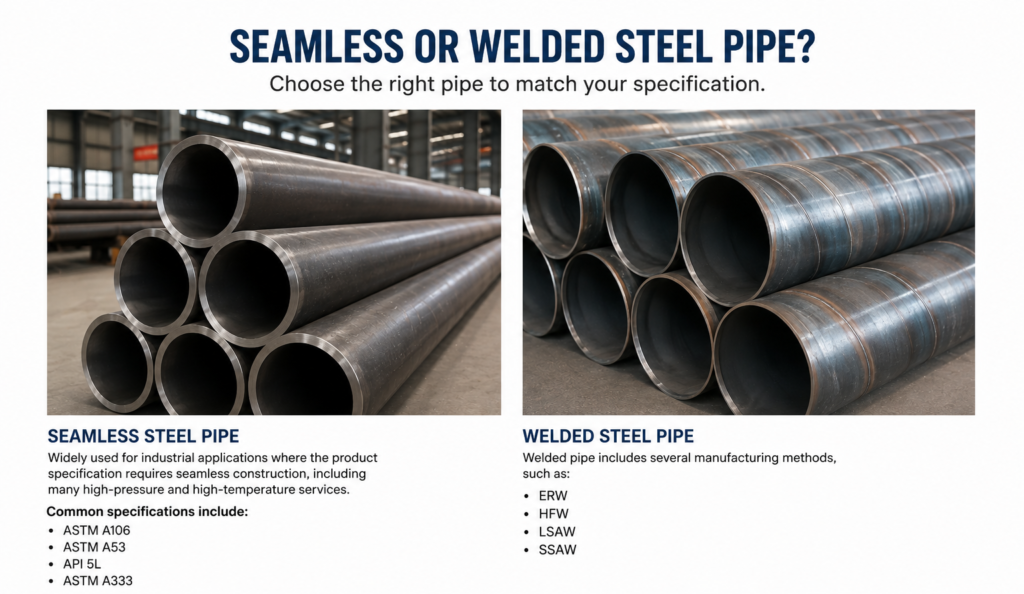
Buying steel pipe for distribution is different from buying pipe for a single project.
A steel pipe distributor, stockist, wholesaler, or trading company has to consider more than the purchase price. The right product mix, material specification, quality, documentation, logistics, and supplier reliability all affect the final cost and resale value.
A low price is not always the best deal. If the pipe does not match the required specification, the documentation is incomplete, or the material cannot be accepted by your customer, the actual cost can be much higher.
This guide covers the key points distributors should consider when sourcing carbon steel pipe, seamless steel pipe, welded steel pipe, and API 5L pipe.
1. Start With a Complete Specification
Before requesting a quotation, define exactly what you need.
A typical steel pipe specification should include:
- Pipe Size: NPS / DN / OD
- Wall Thickness: SCH 40 / SCH 80 / SCH 160 or exact WT
- Material Standard: ASTM A53 / ASTM A106 / API 5L, etc.
- Grade: Grade B / X42 / X52 / X60 / X65, etc.
- Manufacturing Method: Seamless / ERW / LSAW / SSAW
- Length: Random or fixed length
- Pipe Ends: Plain End / Beveled End / Threaded
- Testing: Hydrostatic test / NDE / mechanical testing
- Documentation: MTC / inspection certificate
- Packing and Marking: According to customer or project requirements
A complete specification allows suppliers to provide comparable quotations and reduces the risk of receiving material that does not match the purchase order.
2. Seamless or Welded Steel Pipe?
This is one of the first decisions a distributor needs to make.
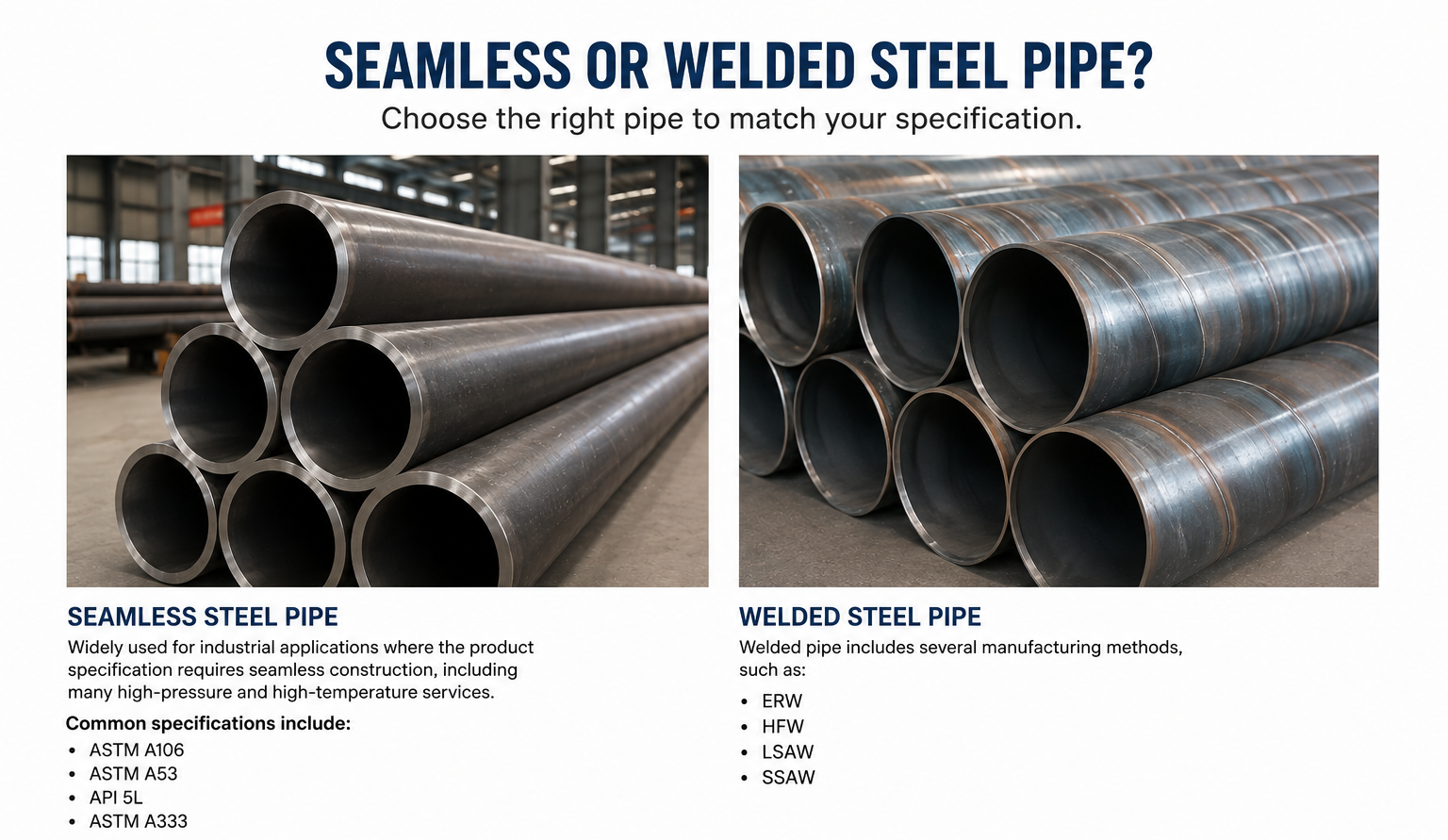
Seamless Steel Pipe
Seamless steel pipe is widely used for industrial applications where the product specification requires seamless construction, including many high-pressure and high-temperature services.
Common specifications include:
- ASTM A106
- ASTM A53
- API 5L
- ASTM A333
Welded Steel Pipe
Welded steel pipe includes several manufacturing methods, such as:
- ERW steel pipe
- LSAW pipe
- SSAW pipe
The appropriate manufacturing method depends on pipe size, material specification, application, project requirements, and cost.
For distributors, seamless pipe should not automatically be considered a replacement for welded pipe, or vice versa. The manufacturing method should match the customer’s specification.
If a customer specifies seamless pipe, changing to ERW or another welded pipe should only be considered when the applicable specification and project requirements allow it.
3. ASTM or API — Which Standard Does Your Customer Need?
ASTM and API are not interchangeable labels.
ASTM specifications such as ASTM A53 and ASTM A106 define specific steel pipe products and their requirements.
API 5L is widely used for line pipe applications in the oil and gas industry and includes requirements covering pipe grades, manufacturing, testing, and product specification levels.
For distributors, the important question is not simply “ASTM or API?” but:
Which standard and grade does your customer require?
For example:
| Typical Application | Common Specification |
|---|---|
| General industrial piping | ASTM A53 |
| High-temperature service | ASTM A106 |
| Oil & gas line pipe | API 5L |
| Low-temperature service | ASTM A333 |
| Project-specific applications | Customer / Project Specification |
Click here to get ASTM A53 vs API 5L steel pipe
Always confirm the exact grade, applicable edition, PSL where required, testing requirements, and any additional customer specifications before purchasing.
4. SCH 40 or SCH 80?
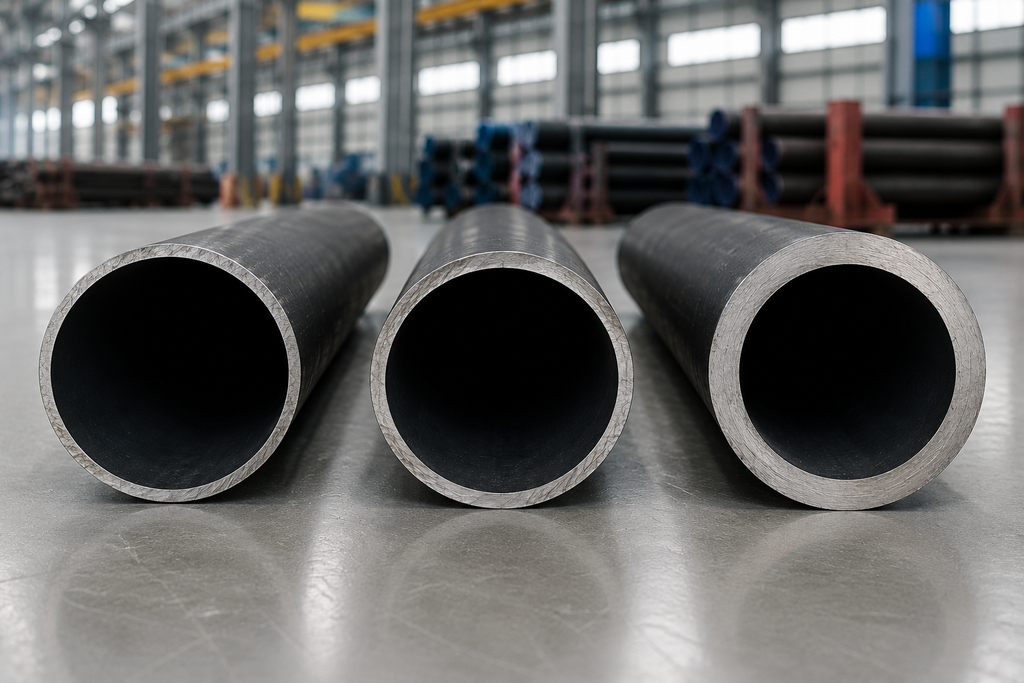
Pipe schedule is used to identify the wall thickness of a pipe for a particular nominal size.
Common requirements include:
SCH 40, SCH 80, SCH 160, STD, XS, and XXS.
For the same nominal pipe size, a higher schedule generally means a thicker wall and heavier pipe.
However:
Pipe schedule is a dimensional designation, not a pressure rating.
The actual allowable pressure depends on factors such as material, temperature, wall thickness, corrosion allowance, design conditions, and the applicable engineering requirements.
For distributors, SCH 40 is often suitable for general industrial applications, while SCH 80 and heavier-wall pipe are more commonly purchased for demanding services or specific project requirements.
Never select a schedule simply because it is thicker. Always match it to the customer’s technical specification.
5. Which Steel Pipe Grades Should You Stock?
There is no universal stocking strategy for every steel pipe distributor.
Your inventory should reflect your local market, customer base, historical sales, and project demand.
Common carbon steel pipe grades may include:
- ASTM A53 Grade B
- ASTM A106 Grade B
- API 5L Grade B
- API 5L X42
- API 5L X52
- API 5L X60
- API 5L X65
For Oil & Gas and EPC customers, API 5L grades and PSL requirements can be particularly important.
For general industrial customers, ASTM A53 and ASTM A106 may have broader applications.
The best inventory is not the inventory with the largest number of grades. It is the inventory that matches what your customers actually buy.
6. Which Pipe Sizes Should You Stock?
Inventory decisions should be based on actual sales data and customer demand.
For many distributors, frequently requested sizes can form the core of their inventory, while larger diameters and less common specifications may be purchased against specific projects.
Before building stock, review:
- Previous sales
- Customer RFQs
- Local construction activity
- Oil & Gas projects
- Petrochemical projects
- Water and infrastructure demand
- Common schedules
- Required material grades
A reliable supplier should also be able to support project-based and mixed-size orders, allowing distributors to purchase less frequently used sizes when needed instead of keeping excessive inventory.
7. What Documents Should You Request?
For professional distribution, documentation is part of the product.
Depending on the specification and customer requirements, you may need:
- Material Test Certificate (MTC)
- Chemical composition
- Mechanical test results
- Hydrostatic test results
- NDE/NDT reports
- Heat number and material traceability
- Dimensional inspection records
- Third-party inspection reports
- EN 10204 3.1 or 3.2 certification where required
For API 5L and major Oil & Gas projects, traceability and documentation can be especially important.
Do not wait until shipment to ask about documents.
Confirm the documentation requirements before production starts.
8. How Should You Compare Steel Pipe Suppliers?
Never compare suppliers based only on the price per ton.
A better comparison considers the complete landed cost:
Product Price + Inspection + Inland Freight + Ocean Freight + Duties/Charges + Other Import Costs
Then compare the technical specifications line by line.
Check:
- Same standard?
- Same grade?
- Same schedule?
- Same manufacturing method?
- Same length?
- Same testing?
- Same MTC requirements?
- Same inspection level?
- Same packing?
- Same delivery terms?
A supplier offering a lower price for a different specification is not actually offering a lower price for the same product.
9. How Can Distributors Reduce Shipping Costs?
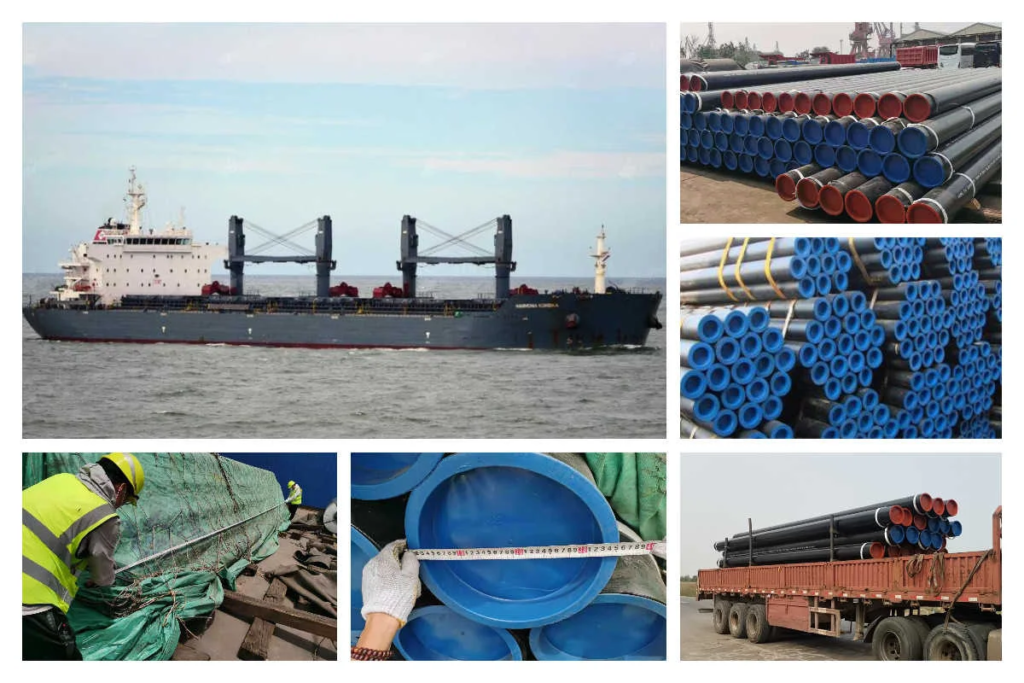
Steel pipe is a heavy product, so logistics can have a major impact on the final selling price.
Optimize Container Loading
Use available container capacity efficiently while staying within applicable weight and loading limits.
Combine Suitable Sizes
For appropriate orders, combining different sizes or specifications in one shipment can improve freight efficiency.
Plan Lengths Carefully
Length requirements can affect both production efficiency and container utilization.
Control Packing
Packing should protect the pipe during handling and transportation without adding unnecessary weight or volume.
Consolidate Orders
For regular customers, planned purchasing and larger shipments can often reduce the logistics cost per ton.
The objective is not simply to reduce freight costs. It is to achieve a lower total landed cost without compromising the required specification.
10. How to Avoid Non-Conforming Steel Pipe
One of the biggest risks for distributors is receiving pipe that appears correct but does not fully match the purchase order.
Before production, confirm:
Standard → Grade → Size → Schedule → Manufacturing → Testing → Documentation
Before shipment, check:
- Outside diameter
- Wall thickness
- Length
- Pipe ends
- Surface condition
- Marking
- Heat numbers
- Quantity
- MTC
- Test reports
- Packing
For large project orders, third-party inspection can also be arranged when required.
A clear purchase order is one of the simplest ways to prevent disputes.
For example:
NPS 6″ × SCH 80 × ASTM A106 Grade B × Seamless × BE × 12M × Hydro Tested × MTC 3.1
This is much safer than simply ordering:
6″ Carbon Steel Pipe
The complete specification gives both buyer and supplier the same technical reference.
Steel Pipe Buying Checklist for Distributors
Before confirming an order, ask:
Product
- What standard?
- What grade?
- What NPS / OD?
- What schedule / wall thickness?
- Seamless or welded?
- What length?
- What pipe ends?
Quality
- What testing is required?
- Is NDE required?
- Is hydrostatic testing required?
- Is third-party inspection required?
Documentation
- Is an MTC required?
- What certification level?
- Is heat-number traceability required?
Logistics
- What is the total quantity?
- How many pieces?
- How will the pipe be packed?
- How many containers are required?
- What is the destination?
Commercial
- Unit price
- MOQ
- Lead time
- Payment terms
- Inspection cost
- Freight cost
- Delivery terms
Final Thoughts: Buy for Your Market, Not Just for the Lowest Price
For a steel pipe distributor, stockist, or wholesaler, successful purchasing is not simply about finding the cheapest supplier.
It is about buying the right specification at the right landed cost, with consistent quality and documentation that your customers can accept.
A good supplier should understand the requirements behind ASTM and API standards, pipe schedules, seamless and welded manufacturing, inspection, documentation, packing, and export logistics.
If you are sourcing carbon steel pipe, seamless steel pipe, API 5L pipe, ASTM A106 pipe, or ASTM A53 pipe for distribution or project supply, provide your size, schedule, grade, quantity, length, and delivery destination.
A complete specification allows us to review your requirements accurately and provide a quotation based on the actual product you need—not simply a generic price per ton.
Email: info@jssteelpipes.com
WhatsApp: +8618003119682