In the carbon steel pipe industry, ASTM A106 and ASTM A53 are two of the most frequently used specifications. At first glance, they look identical, and in many cases, they are even “dual-certified.”
However, using the wrong one in a high-pressure or high-temperature environment can lead to catastrophic failure. To help you source the right material for your project, JSFITTINGS has broken down the five critical differences between these two standards.
1. Scope and Application: Where are they used?
The most fundamental difference lies in their intended environment:
- ASTM A53: This is a general-purpose pipe standard. It is designed for mechanical and pressure applications and is commonly used for transporting air, steam, water, and gas in low-to-medium pressure systems.
- ASTM A106: This is specifically a high-temperature seamless carbon steel pipe standard. It is the industry requirement for refineries, power plants, boilers, and ship construction where fluids are transported at elevated temperatures and pressures.
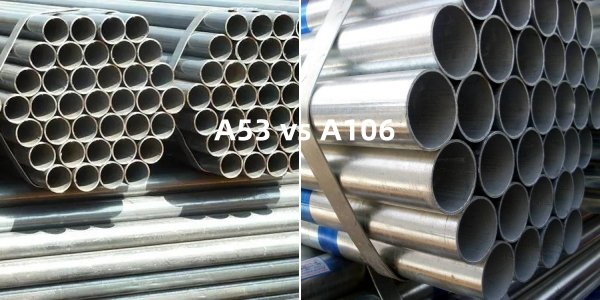
2. Manufacturing Process: Seamless vs. Welded
How the pipe is made determines its strength and cost:
- ASTM A53 can be manufactured as either Seamless (Type S) or Welded (Type E – ERW, or Type F – Furnace Butt-Welded).
- ASTM A106 is ONLY available as Seamless pipe.
If your project specifications strictly require seamless pipe for safety reasons, A106 is often the default choice, though A53 Grade B Seamless is also widely available.
3. Chemical Composition: The “Silicon” Factor
This is a technical detail that engineers watch closely.
The biggest chemical difference is the Silicon (Si) content:
- ASTM A106 contains a minimum of 0.10% Silicon. Silicon acts as a “deoxidizer” in the steel-making process (creating “killed steel”). This makes the pipe more heat-resistant and durable in high-temperature environments.
- ASTM A53 has 0% Silicon content requirements (it is typically unkilled steel).
Why it matters: Without silicon, the steel can become brittle over time when exposed to extreme heat.
4. Mechanical Properties: Grade A vs. Grade B
Both standards have Grades A and B. However, Grade B is the most common in the market for both due to its higher strength.
| Property | ASTM A53 Grade B | ASTM A106 Grade B |
| Tensile Strength (min) | 60,000 psi (415 MPa) | 60,000 psi (415 MPa) |
| Yield Strength (min) | 35,000 psi (240 MPa) | 35,000 psi (240 MPa) |
While the strengths look similar on paper, A106 Grade B is tested more rigorously for its ability to maintain these properties under intense heat.
5. What is “Dual Certified” Pipe? (A53/A106)
In many stockyards, you will see pipes stenciled as “ASTM A53/A106 B.”
This means the pipe has been manufactured and tested to meet the requirements of both standards simultaneously.
For Stockists: Buying dual-certified pipe is highly efficient because it allows you to supply one product to customers regardless of which of the two specs they require, reducing your inventory complexity.
Summary: Which one should you choose?
- Choose ASTM A53 for general plumbing, low-pressure air lines, or structural applications where cost-efficiency is a priority.
- Choose ASTM A106 for high-heat applications (above 400°F/200°C), steam lines, and critical refinery infrastructure.
Why Source Your Pipes from JSFITTINGS?
At JSFITTINGS, we don’t just sell pipes; we provide technical assurance. Whether you need A106 for a power plant or A53 for a commercial construction project, we ensure:
- Full Traceability: Every pipe comes with an MTC (Mill Test Certificate) showing the chemical and mechanical test results.
- Dual Certification: We stock large quantities of A53/A106 dual-spec pipes for immediate global shipping.
- Expert Consulting: Not sure which grade your project needs? Our technical team led by Lisa Wang is available for a one-on-one consultation.
Get a Competitive Quote Today
Don’t let procurement delays hold up your project. Contact us for the latest price list and stock availability.
- Email: info@jssteelpipes.com
- WhatsApp: +8618003119682
- Browse Our Inventory