We regularly receive enquiries that read: “A106 or API 5L, whichever is cheaper.” That question cannot be answered until you know what the pipe is for and which code the line is designed to. The three specifications below all carry a Grade B and all land around 35 ksi minimum yield. They are still not interchangeable.
This guide is written for stockists who need to know what they are buying and for project buyers comparing mill offers. It compares the three Grade B specifications on chemistry, mechanical properties, manufacturing route, temperature duty and documentation — and points out the substitutions that cause problems on site.
Short answer API 5L Grade B is line pipe for oil, gas and water transmission, supplied welded or seamless, at PSL1 or PSL2. ASTM A106 Grade B is seamless-only pipe intended for high-temperature process piping such as steam, refineries and power plants. ASTM A53 Grade B is general-service pipe, seamless or ERW, black or galvanized, used for water, gas, air and structural work. All three have a minimum yield of about 240–245 MPa (35 ksi) and a minimum tensile of 415 MPa (60 ksi). The grade name tells you the strength class — it does not tell you the duty. Export minimum at JS FITTINGS is 1,000 metric tons.
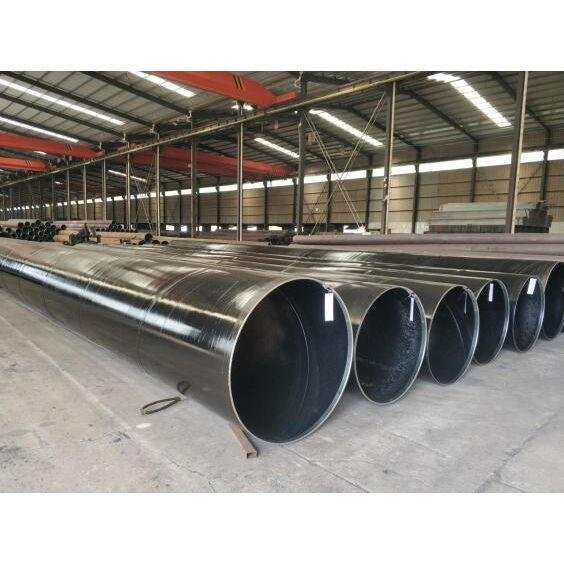
The three specifications at a glance
| API 5L Grade B (L245) | ASTM A106 Grade B | ASTM A53 Grade B | |
| Main use | Oil, gas and water transmission pipelines | High-temperature process and power piping | General water, gas, air, steam and structural service |
| Manufacturing route | Seamless, ERW, LSAW, SSAW | Seamless only | Type S seamless, Type E ERW, Type F furnace butt weld (limited sizes/grades) |
| Min yield | 245 MPa (35.5 ksi) | 240 MPa (35 ksi) | 240 MPa (35 ksi) |
| Min tensile | 415 MPa (60 ksi) | 415 MPa (60 ksi) | 415 MPa (60 ksi) |
| Chemistry control | PSL1 basic; PSL2 tight + carbon equivalent | Ranges for C and Mn; Si minimum 0.10% | Ceilings only; no silicon requirement |
| Impact test | Mandatory at PSL2 | Not a general requirement | Not required |
| Galvanized option | Not typical for line pipe | No | Yes — black or hot-dip galvanized |
| Typical design code | ASME B31.4, B31.8 (pipe manufactured to API Spec 5L) | ASME B31.1, B31.3 | General plumbing and low-pressure work |
| Can it be ordered welded? | Yes | No | Yes (Type E) |
The first thing to notice is that the strength numbers are almost the same. If someone tells you A106 is “stronger” than A53, ask them to show the yield column — it is 240 MPa for both. The real differences are in chemistry control, manufacturing route, test requirements and the code that allows the pipe to be used.
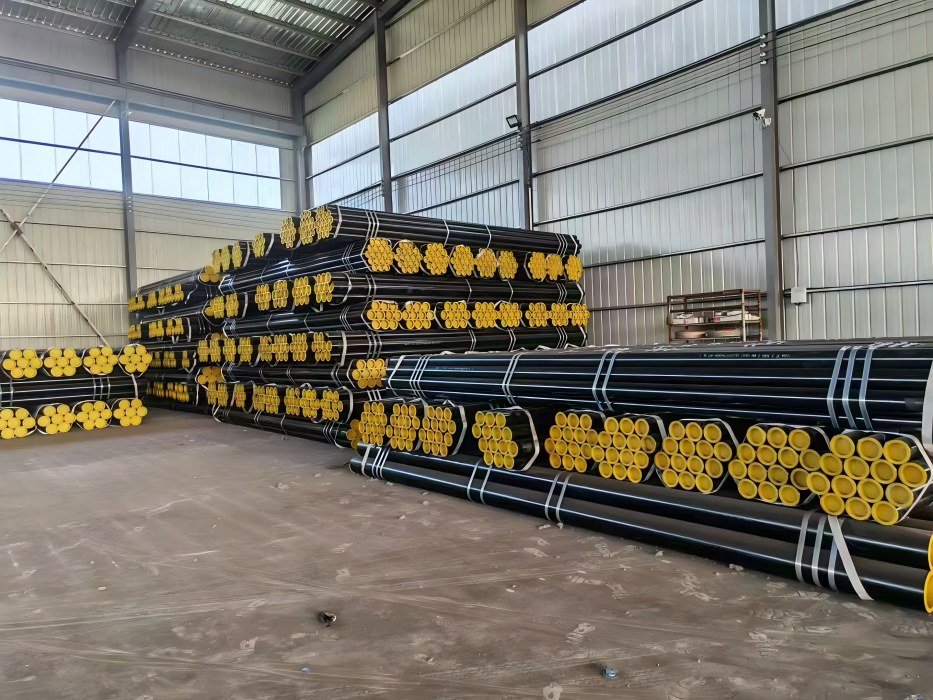
ASTM A106 Grade B chemical composition and why it matters
Buyers searching for ASTM A106 Grade B chemical composition are usually trying to work out whether a heat will weld cleanly and hold up at temperature. The published limits for Grade B are:
| Element | ASTM A106 Gr.B | ASTM A53 Gr.B | API 5L Gr.B PSL1 | API 5L Gr.B PSL2 |
| Carbon (C), max | 0.30% | 0.30% | 0.28% | 0.22% |
| Manganese (Mn) | 0.29–1.06% | 1.20% max | 1.20% max | 1.20% max |
| Silicon (Si) | 0.10% min | not specified | — | — |
| Phosphorus (P), max | 0.035% | 0.050% | 0.030% | 0.025% |
| Sulphur (S), max | 0.035% | 0.045% | 0.030% | 0.015% |
Note: For API 5L Gr.B PSL1, 0.28% max C applies to seamless (0.26% max for welded). For PSL2 (L245), C max depends on delivery condition (e.g. 0.22% for L245M, 0.24% for L245R/N).
Published specification limits, current editions. Each standard has its own carbon–manganese adjustment rules and residual-element caps; always read the actual mill test certificate rather than a copied table.
Two details in this table do more work than the rest:
- A106 requires a silicon minimum of 0.10%. That means fully killed, deoxidised steel. A53 sets no silicon requirement at all. This is one of the reasons A106 is the specification for elevated-temperature service and A53 is not.
- A53 allows higher phosphorus and sulphur. That is fine for general service, but it changes weld behaviour and toughness. It is not a defect — it is a different job.
For API 5L, the PSL2 column is the one that matters for most projects. Lower carbon and sulphur, mandatory Charpy testing and carbon-equivalent control make PSL2 easier to field-weld and traceable back to the heat. Saying “API 5L Gr.B” without saying PSL1 or PSL2 leaves the mill to choose.
When to choose each specification
Choose API 5L Grade B when the pipe is a pipeline. Long-distance oil, gas or water transmission, whether ERW, LSAW or SSAW, is line pipe territory. State the PSL level, the delivery condition (as-rolled, normalized, thermomechanically rolled) and the weld NDT scope. Our SSAW bulk project buyer guide covers the line-pipe route in detail.
Choose ASTM A106 Grade B when the pipe is process piping at temperature. Steam lines, refinery piping, boiler feedwater and power-plant work normally call for A106 because the allowable stresses at temperature come from the ASME codes that adopt it. A106 is seamless only. If your enquiry asks for “A106 welded”, something is wrong with the specification. Our comparison of ASTM A333 and ASTM A106 pipes covers the low-temperature alternative.
Choose ASTM A53 Grade B when the duty is general. Water, gas, air, low-pressure steam, fire sprinklers, handrails and scaffolding are typical A53 applications. If you need galvanized pipe, A53 is the specification that covers black and hot-dip galvanized product. For structural hollow sections, a structural specification such as ASTM A500 is usually more appropriate than A53.
ASTM A106 Grade B seamless pipe may be acceptable as a substitute for certain ASTM A53 Grade B seamless applications, provided the applicable design code, dimensional requirements, testing scope and purchaser specifications are satisfied. Substitution should always receive engineering or purchaser approval.
Dual certification: the option buyers forget
A seamless pipe can be certified to more than one specification at the same time. The common combinations are:
- ASTM A106 Gr.B / API 5L Gr.B seamless
- ASTM A53 Gr.B Type S / ASTM A106 Gr.B seamless
- ASTM A53 Gr.B / API 5L Gr.B for certain line-pipe lots
When this happens, the MTC should show both designations and the pipe should be stencilled accordingly. Do not assume dual certification from a verbal promise, and do not accept a certificate that lists only one of the two if your project requires both.
There is a hard limit to remember: A welded pipe cannot be certified to ASTM A106, because A106 is a seamless-only specification. If a supplier offers “A106 ERW”, walk away from that offer.
Five substitution traps
- Using A53 in place of A106 at temperature. Similar yield strength, different chemistry control and no silicon requirement. The design code will usually reject it.
- Using API 5L line pipe for process piping without approval. Different test regime, different code basis. A pipeline grade is not automatically an ASME B31.3 material.
- Assuming “Grade B” means the same chemistry everywhere. Compare the P, S and carbon-equivalent columns, not the grade name.
- Ordering API 5L without PSL. PSL1 and PSL2 have different NDT, impact and traceability requirements — and different prices.
- Forgetting the type on an A53 order. “A53 Gr.B” is incomplete. Type S (seamless) and Type E (ERW) are different products with different weld seams and inspection.
What to put in a 1,000-ton RFQ
A usable RFQ line looks like this:
ASTM A106 Gr.B seamless, NPS 8, Sch 40, 12 m, beveled ends, EN 10204 3.1 MTC, hydrotest, UT, 1000 MT total.
Or, for line pipe:
API 5L Gr.B PSL2 SAWH, OD 610 mm, WT 9.5 mm, 12 m, beveled ends, FBE 400 µm, full MTC and coating report, 1,000 MT total.
Include the standard and grade and type/process, the PSL where applicable, size and schedule, length and end finish, inspection scope, and the destination port. Our carbon steel pipe grades guide and Sch 40 vs Sch 80 reference cover the dimensional side. For welded supply, see the ERW pipe guide.
FAQ
Is API 5L Gr.B the same as ASTM A106 Gr.B? No. Both have roughly the same minimum yield and tensile strength, but API 5L is line pipe for transmission systems and may be welded or seamless, while A106 is seamless-only pipe for high-temperature service. A seamless pipe can be dual-certified to both; the two specifications are not identical.
Can ASTM A53 Gr.B replace ASTM A106 Gr.B? Usually not. A53 is general-service pipe with looser chemistry limits and no silicon requirement. A106 is the specification used for elevated-temperature code work. A106 can generally cover an A53 duty; A53 should not be substituted into an A106 duty without design approval.
Which of the three is strongest? At room temperature, they are nearly equal: 240–245 MPa minimum yield and 415 MPa minimum tensile. The differences lie in chemistry control, test requirements and temperature capability, not in the headline strength number.
Can A106 pipe be welded on site? Yes. A106 pipe is manufactured seamless, but it is carbon steel and is routinely field-welded. The confusion is about how the pipe is made, not whether the installer may weld it.
Why does my MTC show two specifications? Because the heat and the pipe met both sets of requirements, the mill certified it to both. Check that both designations appear on the certificate and on the pipe stencil — a verbal claim is not enough.
Working with us
Send the specification as written in your project standard — including grade, type or PSL, size, schedule, length, end finish and inspection scope. We will confirm what can be supplied against that exact designation, provide a sample MTC and return a loading plan for a 1,000-ton export lot.
Email: info@jssteelpipes.com
WhatsApp: +8618003119682
Technical content reviewed November 2026. Standards referenced: API Spec 5L, ASTM A106/A106M, ASTM A53/A53M, ASME SA-106, ASME SA-53 (current editions). Confirm the edition and project addenda with the mill before ordering.