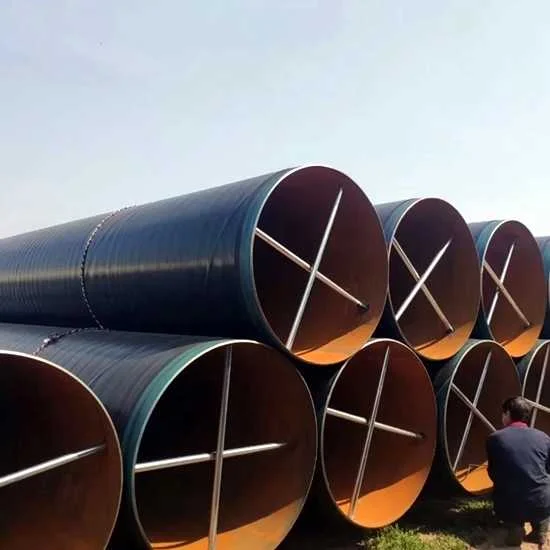
An FBE coated pipe enquiry usually arrives with a size, a quantity and the words “epoxy coated”. What is missing is the part that decides whether the coating survives shipping, handling and thirty years underground: the dry film thickness, the blast profile, the holiday test and the repair procedure. Those four items are also the reason two quotes for the same pipe can differ by a surprising amount.
This guide is for distributors stocking coated line pipe and for project buyers specifying corrosion protection. It explains what FBE coated pipe is, how to write the coating clause, how FBE compares with 3LPE, and what to check before a 500-ton export order is loaded.
Short answer FBE (fusion bonded epoxy) coated pipe is carbon steel pipe with a plant-applied epoxy powder film, typically 350–500 µm (14–20 mil) for a single-layer external system. The usual standards are ISO 21809-2, CSA Z245.20 and, for water service, AWWA C213. For a bulk order, confirm five things: surface preparation (Sa 2½, 50–100 µm anchor profile), target and minimum DFT, full-length holiday detection calibrated to the actual film, the field repair kit, and coated-pipe packing with padded slings and spacers. Export minimum at JS FITTINGS is 500 metric tons.

What FBE coated pipe actually is
The pipe is blast cleaned to near-white metal, heated to around 230–250 °C, and epoxy powder is sprayed electrostatically onto the hot surface. The powder melts, flows and cures into a continuous thermoset film. There is no solvent to evaporate, which is why FBE is widely specified for buried and submerged pipelines.
Two terms cause confusion in RFQs:
- External FBE protects the outside of a buried line, usually together with cathodic protection.
- Internal FBE (often called a lining) protects the conveyed product and improves flow. For potable water, AWWA C213 linings are commonly in the 250–400 µm range — thinner than many external specifications.
If your enquiry says only “FBE coated”, say which side you mean. The price and the test regime are not the same.
The coating clause you can copy into an RFQ
| Item | What to specify | Why it matters |
| Standard | AWWA C213 water service (external or internal lining) | Defines test methods and acceptance limits |
| Surface preparation | ISO 8501-1 Sa 2½; anchor profile 50–100 µm | Most coating failures start here, not in the powder |
| Preheat | Typically 230–250 °C, per powder supplier data sheet | Too cold = poor cure; too hot = powder degradation |
| Dry film thickness | State target and minimum, e.g. 400 µm nominal / 350 µm minimum | “350–500 µm” alone gives a mill room to ship at the bottom |
| Holiday detection | 100% of length, voltage set from actual DFT | Over-voltage burns sound epoxy; under-voltage misses pinholes |
| Adhesion / cathodic disbondment | Ask for qualification report plus production lot results | Proves the system, not just the powder brand |
| Repair | Approved patch procedure and repair kit for field damage | Coated pipe will be handled; damage is a question of when, not if |
| Marking | Heat number, pipe number, coating batch, DFT record | Ties the coating report back to the MTC |
| Weld cutback | Typically 100–150 mm (4–6 in.) uncoated at each beveled end | Leaves bare steel for field welding without grinding off cured epoxy on site |
A specification without the DFT minimum and the holiday-test voltage is not really a specification. It is a colour description.
FBE vs 3LPE vs dual-layer FBE: which one to buy
| System | Structure | Typical total thickness | Best for | Trade-off |
| Single-layer FBE | One epoxy film | 350–500 µm | Buried oil/gas and water lines with cathodic protection | Less resistant to rock damage than 3LPE |
| Dual-layer FBE | Epoxy + top epoxy layer | ~650–1,000 µm | Higher mechanical demand, strain-prone sections | Higher powder cost and stricter process control |
| 3LPE | FBE primer + adhesive + polyethylene | ~1.8–3.7 mm depending on OD | Rocky backfill, aggressive soil, large-diameter lines | Thicker film; field joint wrapping is more involved |
| 2PE | Adhesive + polyethylene, no FBE primer | ~1.8–3.0 mm | General burial where cost is dominant | Lower adhesion than 3LPE |
A useful rule from the field: if the trench has rock or the line will be dragged, 3LPE earns its cost. If the line is conventional burial with good padding and cathodic protection, single-layer FBE is usually the better-value specification. Do not solve a mechanical-damage problem by simply making the FBE film thicker — beyond the designed DFT the film gets less tolerant of bending and impact.
For the steel pipe underneath the coating, see our SSAW bulk project buyer guide and our FBE coated pipe product page.
Four coating problems that show up after loading
- Holidays that were never found. The detector was set from a nominal thickness, not the measured film. Pinholes reach the steel and become corrosion sites under cathodic protection.
- Blast profile out of range. A smooth surface gives poor keying; an over-aggressive profile leaves peaks that the film does not cover. Both fail adhesion tests.
- Over-thick single-layer FBE. Ordered as “extra protection”, it cracks during handling or field bending. Specify dual-layer FBE or 3LPE instead if you need more protection.
- Damage from stacking and slings. Coated pipe needs padded slings, spaced supports and no direct steel-to-film contact. A supplier who quotes coating but ships without rubber-lined handling has not finished the job.
Bulk export checklist for coated pipe
- Freeze the steel designation first. Grade, PSL, OD, wall, length and end finish must be settled before the coating clause is priced. Our carbon steel pipe grades guide and Sch 40 vs Sch 80 wall thickness reference help with that step.
- Set inspection hold points. Review MTCs before coating; inspect blast profile and preheat during coating; witness holiday detection and DFT measurement; inspect again before loading.
- Ask for the coating production report. DFT readings by pipe, powder batch number, holiday-test voltage and any repair log should be traceable to pipe numbers.
- Plan the load. 12 m coated pipe normally goes in 40-ft containers. For 1,000 MT, expect roughly 35–40 containers depending on diameter and wall. Very large diameters go break-bulk. Coated pipe needs dunnage and spacers; confirm who pays for it.
- Confirm Incoterms and port. FOB, CFR or CIF to a named port, with the coating-protection obligations written into the loading clause.
- Order the repair kit with the pipe. Field welds and site handling will damage the film. A kit with approved patch material avoids a makeshift repair that fails the holiday test.
What changes the price per ton
Steel cost sets the base. After that: powder type and DFT, surface preparation media, energy for preheat, inspection scope, packing materials and freight. A quote that says “FBE coated” without film thickness or test scope cannot be compared fairly with one that states 400 µm nominal, Sa 2½ prep and 100% holiday detection. Ask every supplier to quote the same written clause.
FAQ
What is FBE coated pipe? Carbon steel pipe with a plant-applied fusion bonded epoxy powder film. It is used mainly for external corrosion protection on buried oil, gas and water pipelines, and internally as a lining for water service.
How thick should FBE coating be? For a single-layer external system, 350–500 µm (14–20 mil) is the common range, with the exact target and minimum set by the project standard. Internal water linings are often 300–400 µm (12–16 mil). Dual-layer and 3LPE systems are thicker.
Is FBE better than 3LPE? Neither is universally better. FBE has strong adhesion and is widely used with cathodic protection. 3LPE adds a polyethylene outer layer that resists rock damage and aggressive soil. The backfill and service conditions decide.
Can FBE coating be repaired on site? Yes, with an approved repair procedure and compatible patch material. The repaired area must be re-tested with a holiday detector at the correct voltage. Always order the repair kit with the pipe.
What documents should come with a bulk coated-pipe order? Mill test certificates with heat numbers, coating production report with DFT readings and holiday-test records, powder batch certificates, packing list with pipe numbers, and third-party inspection reports if hold points were agreed.
Working with us
Send OD, wall thickness, grade, quantity, service (oil, gas, water or structural), required coating system and DFT, and destination port.
You will receive a specification confirmation sheet, a coating-report sample and a container-loading estimate. Export minimum: 500 metric tons.
Email: info@jssteelpipes.com
WhatsApp: +8618003119682
Technical content reviewed November 2026. Standards referenced: ISO 21809-2, CSA Z245.20, AWWA C213, ISO 8501-1, API Spec 5L (current editions). Confirm the edition and project addenda with the mill before ordering.