Most problems with steel pipe orders are not quality problems. They are specification problems, and they start with one word: schedule.
A schedule is an index, not a number to bargain with
For any given nominal pipe size, the outside diameter is fixed. Schedule only changes how thick the wall is, and the extra steel is added inward, so the bore gets smaller. That single fact explains why a “6 inch pipe” can carry wildly different amounts of fluid depending on what is behind the SCH.
The older weight classes still appear on drawings and POs, and knowing where they line up saves arguments:
- STD equals SCH 40 up to NPS 10, then holds at 9.53 mm wall regardless of size.
- XS equals SCH 80 up to NPS 8, then holds at 17.48 mm wall.
- XXS has no simple schedule equivalent and is specified by wall, not by schedule.
Within the relevant pipe diameter ranges, the nominal wall thicknesses for STD and XS are maintained at approximately 9.53 mm and 12.70 mm, respectively—rather than these two thicknesses being applied to all pipe diameters.
Above those crossover points, STD and SCH 40 stop meaning the same thing. If a drawing says “STD wall” on a 12 inch line, confirm which one the designer intended before you place the order.
SCH 40 is twelve different wall thicknesses
This is the mistake we correct most often. A buyer asks for “SCH 40” as if it were one wall. On a half-inch line it is 2.77 mm. On a 12 inch line it is 10.31 mm. Same schedule, nearly four times the steel.
Selected nominal wall thicknesses to ASME B36.10M, with weight per meter calculated at 7.85 kg/dm³:
| NPS | OD (mm) | SCH 40 (mm) | SCH 80 (mm) | SCH 160 (mm) | SCH 40 wt (kg/m) | SCH 80 wt (kg/m) |
| 2″ | 60.3 | 3.91 | 5.54 | 8.74 | 5.44 | 7.48 |
| 4″ | 114.3 | 6.02 | 8.56 | 13.49 | 16.07 | 22.32 |
| 6″ | 168.3 | 7.11 | 10.97 | 18.26 | 28.26 | 42.56 |
| 8″ | 219.1 | 8.18 | 12.70 | 23.01 | 42.55 | 64.64 |
| 12″ | 323.9 | 10.31 | 17.48 | 33.32 | 79.72 | 约 132 |
Practically, this table does two jobs. It tells your estimator what the tonnage will be before a single quote comes back, and it shows why a schedule upgrade on large-diameter line is a much bigger cost decision than the same upgrade on small bore.
A schedule is not a pressure rating
This is the second costly assumption. SCH 80 does not mean “high pressure” and SCH 40 does not mean “low pressure”, because allowable pressure depends on diameter, material allowable stress, temperature and joint efficiency at the same time.
For design work under ASME B31.3, the pressure design thickness is:
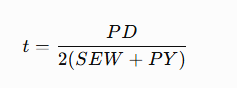
P: Design internal pressure
D: Outside diameter of the pipe
S: Allowable stress of the material at the design temperature
E: Longitudinal weld joint quality factor
W: Weld strength reduction factor (applied where applicable)
Y: A coefficient dependent on factors such as material and temperature
Then add what the formula leaves out: corrosion or erosion allowance, usually 1.5–3.0 mm depending on the medium, and any external loading case the line will actually see.
The undertolerance trap
ASTM A530 permits a manufacturing undertolerance of −12.5% on seamless wall thickness. This is where purchase orders quietly go wrong.
Take NPS 6 SCH 40 at 7.11 mm nominal. At the permitted minimum, the thinnest point on delivered pipe can be 6.22 mm. If your design calculation needed a 7.11 mm minimum wall, not a 7.11 mm nominal, SCH 40 will not satisfy it, and the pipe is still fully compliant with the standard when it arrives.
Two clean ways to avoid this:
- Order the next schedule up and treat the excess as margin.
- Order to minimum wall and state it explicitly, for example “7.11 mm minimum, −0% tolerance” or “SCH 40 with 12.5% undertolerance excluded”.
The second route costs less steel, but it has to be written on the RFQ. Mills quote what is written. Always ask what tolerance band the quote is based on, and confirm the delivered minimum wall rather than the nominal figure.
Schedule choice moves your freight, not just your steel
Steel pipe shipments are often limited by payload rather than floor space. A 20 ft container and a 40 ft container may carry similar net pipe weights under certain shipping arrangements, but the actual loading plan must be checked against container payload limits, carrier requirements, local road restrictions, and the pipe dimensions.
So the schedule decision is really three decisions: what pressure the line must hold, what tonnage you are willing to pay freight on, and what length your site can actually handle.
What to put on the RFQ
Every avoidable claim we see traces back to something that was not written down. Put these six lines on the enquiry:
- Nominal size and OD, plus standard (ASME B36.10M, EN 10216, GOST, or project spec)
- Schedule and minimum wall thickness, with the tolerance band
- Material grade and product specification (API 5L grade, ASTM A106 Grade B, A333 for low temperature, and so on)
- Whether seamless or welded is required, and if welded, which process
- Length, end finish (plain, beveled, threaded) and coating
- Inspection and documentation: MTC to EN 10204 3.1, third-party inspection, hydrostatic or UT requirements
Get those six right and the commercial side becomes straightforward.
Manufacturing route follows the wall
Not every mill can make every wall. High-frequency ERW reaches its cold-forming limit well before heavy wall, so thickness climbs and the route changes. In our own range, ERW pipe is quoted from 1.65 mm to 22 mm wall, LSAW to 40 mm, and seamless pipe covers hot finish 2″–30″ up to 50 mm wall.
If a heavy schedule is offered on a welded route, ask two questions: which welding process, and what joint factor is being applied in the design. A quotation that cannot answer both is a quotation you cannot use in your calculations.
About JS FITTINGS
We are a Chinese industrial steel pipe manufacturer and supplier based in Yanshan, Cangzhou, Hebei, with over 40 years in the trade. Our lines are seamless steel pipes, ERW steel pipes, LSAW and SSAW steel pipes, in industrial grades only.
Common schedules are stocked as SCH 40 carbon steel pipe and SCH 80 carbon steel pipe, with large-diameter and coated pipe for transmission work.
- Standards: API 5L, API 5CT, ASTM A106 / A53 / A333 / A335 / A252 / A500, EN 10210 / 10217 / 10219, DIN, JIS, BS
- Certifications: ISO, CE, GOST-R, PETROBRAS, ADNOC, NIOC
- Capacity: 90+ containers per month, 95% on-time delivery, 15–30 days for one container
- Documentation: mill test certificates to EN 10204 3.1, with third-party inspection (SGS, BV, Intertek or your nominated TPI) scheduled alongside production
Send the six-line specification above and you get a technical response within 2 hours and a priced proposal within 24.
Send us your pipe size, schedule, material grade, manufacturing route, required length and inspection requirements.
JS FITTINGS can review your inquiry and provide a quotation based on the specifications confirmed for your order.
Email: info@jssteelpipes.com
WhatsApp: +86 180 0311 9682
Common questions
What is the difference between SCH 40 and SCH 80 pipe?
Same outside diameter, thicker wall. SCH 80 is heavier, has a smaller bore, and is chosen when the design calculation requires more wall for pressure, corrosion allowance, or mechanical loading. On a 6-inch line, SCH 40 is 7.11 mm and SCH 80 is 10.97 mm.
Is SCH 160 the heaviest schedule available?
No.XXS is a separate traditional wall designation and does not have a universal schedule equivalent. And above that pipe is specified by wall thickness rather than by schedule. On some large sizes XXS and SCH 160 do not follow the same order, so always confirm the actual wall figure.
Is Schedule 40 pipe the same as standard weight pipe?
Only up to NPS 10. From NPS 12 upward, STD holds at 9.53 mm while SCH 40 continues to increase, so the two stop matching.
Can SCH 40 pipe meet a high-pressure requirement?
SCH 40 pipe may be suitable for certain high-pressure applications, depending on nominal size, material, design temperature, allowable stress, joint factors, corrosion allowance and the applicable piping code. Schedule alone does not determine the allowable operating pressure.
How do I specify minimum wall thickness when ordering steel pipe?
State the nominal size, outside diameter, material specification, required minimum wall thickness, applicable dimensional standard and agreed manufacturing tolerance on the RFQ. Confirm that the selected product specification and mill can meet the requirement before placing the order.