API 5L Grade B and ASTM A106 Grade B seamless steel pipes may look similar, and their basic strength levels are close. But they are not simply interchangeable in for an oil & gas, refinery or industrial project.
The important question is not which pipe is “better”. The real question is:
Which specification matches the service, project code and purchasing requirements?
For distributors and project buyers, getting this point wrong can mean more than a technical issue. It can lead to MTC rejection, additional testing, replacement costs or delivery delays.
API 5L Grade B vs ASTM A106 Grade B seamless steel pipes is their intended use.
API 5L is a line pipe specification developed for the petroleum and natural gas industries and is commonly associated with the transportation of oil, gas and other fluids.
ASTM A106 covers seamless carbon steel pipe for high-temperature service and is commonly used in refineries, petrochemical plants, power plants and process piping. ASTM’s specification specifically covers seamless pipe and includes requirements related to bending, flanging and welding.
| Item | API 5L Grade B pipes | ASTM A106 Grade B pipes |
|---|---|---|
| Main purpose | Line pipe | High-temperature seamless pipe |
| Typical application | Oil & gas transmission | Process piping, refinery, power plant |
| Pipe manufacturing | Seamless and welded steel pipe under API 5L | Seamless steel pipes |
| Product Specification Level | PSL1 / PSL2 | No PSL classification |
| Common project concern | Line pipe compliance and traceability | High-temperature pressure service |
| Typical buyer | Pipeline contractors, oil & gas distributors | EPCs, refineries, process piping contractors |
The specifications overlap in some applications, but their design intent and purchasing requirements are different.
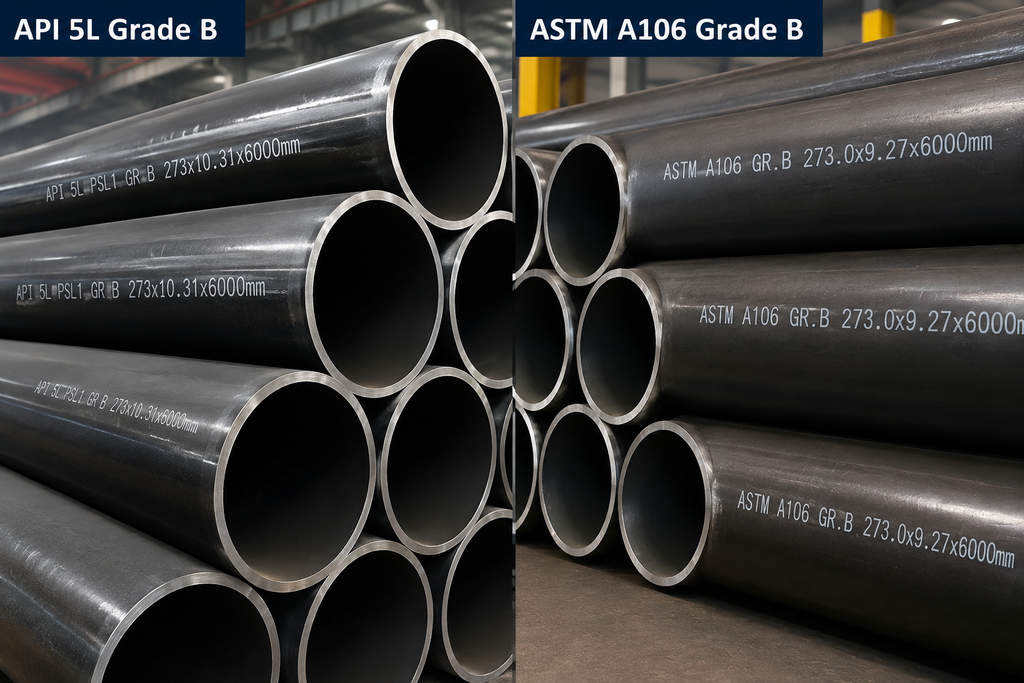
Are API 5L Grade B and ASTM A106 Grade B the Same?
No.
This is one of the most common mistakes in steel pipe purchasing.
API 5L Grade B and ASTM A106 Grade B have similar minimum strength requirements, which is why buyers sometimes assume that one can replace the other.
But similar mechanical properties do not make two specifications equivalent.
The applicable standard also controls requirements such as:
- Chemical composition
- Manufacturing process
- Testing
- Inspection
- Traceability
- Supplementary requirements
- Documentation
API 5L also uses PSL1 and PSL2, with PSL2 generally involving additional and more stringent requirements than PSL1. API’s specification has continued to evolve, including updates covering areas such as hardness testing, marking and strain-based design.
The practical answer for buyers:
Do not approve an A106 Grade B pipe simply because its mechanical properties appear similar to API 5L Grade B.
If the purchase specification says API 5L, obtain project/engineering approval before proposing ASTM A106 as an alternative.
When Should You Choose API 5L Grade B steel pipes?
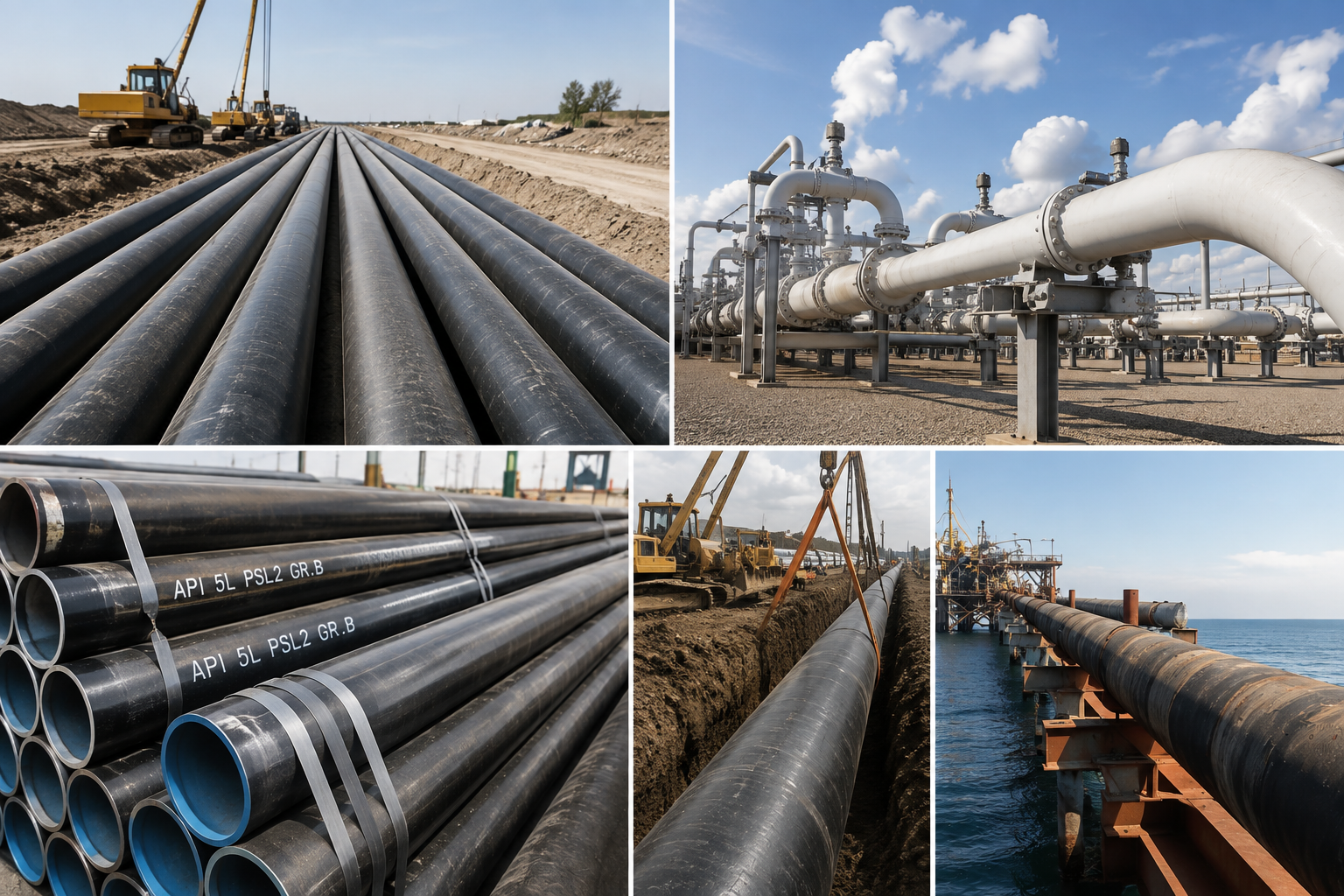
API 5L Grade B is generally the more appropriate starting point when the pipe is specified for line pipe service.
Typical applications include:
- Oil transmission pipelines
- Natural gas pipelines
- Water transmission pipelines
- Gathering systems
- Onshore pipeline projects
- Certain offshore pipeline applications
For these projects, the purchaser may also need to specify PSL1 or PSL2, depending on the project requirements.
For example, an inquiry stating only:
“API 5L Grade B seamless pipe”
may still be incomplete.
The buyer should confirm:
API 5L edition + Grade B + PSL + pipe size + wall thickness + delivery condition + testing + inspection requirements
This is particularly important for EPC and oil & gas projects.
When Is ASTM A106 Grade B Steel Pipe the Better Choice?
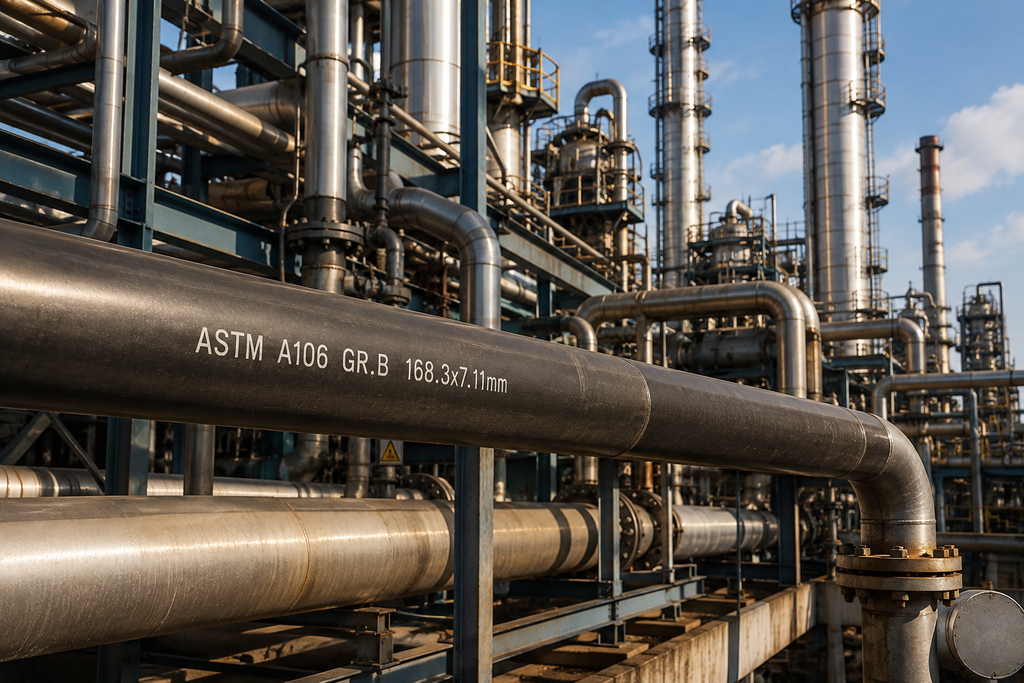
ASTM A106 Grade B is specifically intended for seamless carbon steel pipe used in high-temperature service.
It is commonly specified for:
- Refineries
- Petrochemical plants
- Power plants
- Process piping
- Steam lines
- High-temperature fluid service
For these applications, the operating temperature and pressure are key factors.
A common purchasing mistake is to select API 5L simply because the project is related to oil and gas.
Oil & gas does not automatically mean API 5L.
An oil refinery may use ASTM A106 for process piping while an oil transmission pipeline may use API 5L.
The service and project specification determine the correct standard.
Can API 5L Grade B Replace ASTM A106 Grade B?
Not automatically.
This is another common procurement problem.
Suppose a refinery project specifies:
ASTM A106 Grade B seamless pipe
A supplier may offer:
API 5L Grade B seamless pipe
because the basic mechanical properties appear comparable.
That does not mean the substitution is automatically acceptable.
The engineering team needs to evaluate:
- Design temperature
- Design pressure
- Applicable piping code
- Chemical requirements
- Testing requirements
- Welding requirements
- Project specification
- Client approval requirements
The same principle applies in the opposite direction.
A106 Grade B should not automatically replace API 5L Grade B simply because the pipe is seamless carbon steel.
API 5L PSL1 vs PSL2: Why Does It Matter?
For buyers working on oil & gas projects, PSL is one of the most important details to confirm.
API 5L provides different Product Specification Levels.
In simple purchasing terms:
PSL1 → standard requirements
PSL2 → additional and more stringent requirements
Depending on the specified product and service, PSL2 can involve tighter controls related to chemistry, mechanical testing, NDT, toughness and traceability.
For current projects, always confirm the applicable API 5L edition and project specification rather than relying on an old purchase template. API has issued updates to the 5L specification, including a 47th-edition update in 2026.
API 5L PSL1 vs. PSL2: Critical Differences for Your Pipeline Project
What About Chemical Composition?
This is another reason not to judge equivalence only by yield and tensile strength.
API 5L and ASTM A106 have their own chemistry requirements and acceptance criteria.
For project procurement, the supplier’s MTC should be checked against the exact ordered specification and grade.
For example, buyers should review:
- Carbon
- Manganese
- Phosphorus
- Sulfur
- Silicon
- Carbon equivalent where applicable
For API 5L PSL2 projects, carbon equivalent and other additional controls can become particularly important.
Do not compare two MTCs simply by asking whether both say “Grade B.”
The complete specification matters.
Which Pipe Is Better for Oil & Gas?
There is no universal answer.
Choose API 5L Grade B steel pipes when:
The project is primarily a line pipe application and the project specification calls for API 5L.
Typical examples include:
- Oil transmission
- Gas transmission
- Pipeline construction
- Gathering systems
Choose ASTM A106 Grade B steel pipes when:
The project requires seamless carbon steel pipe for high-temperature process service.
Typical examples include:
- Refineries
- Petrochemical plants
- Steam piping
- Process piping
- Power generation
The key is not simply “oil & gas vs non-oil & gas.”
It is:
Pipeline transportation vs process/high-temperature piping.
A Common Buyer Problem: “The Supplier Says They Are Equivalent”
This situation happens frequently.
A supplier may tell you:
“API 5L Grade B and A106 Grade B are basically the same.”
From a commercial perspective, this may sound convenient.
From a project procurement perspective, it is not enough.
Before accepting the substitution, ask for:
- Exact standard and edition
- Grade
- PSL if API 5L applies
- Chemical composition
- Mechanical test results
- Hydrostatic test records
- NDT requirements
- Heat number traceability
- MTC
- Written approval from the client/engineer if substitution is required
This simple checklist can prevent a surprisingly expensive procurement mistake.
Final Takeaway
API 5L Grade B and ASTM A106 Grade B seamless pipes are similar in some basic mechanical properties, but they are designed for different specification requirements.
The simplest way to remember the difference is:
API 5L → line pipe and fluid transportation
ASTM A106 → seamless pipe for high-temperature service
For a distributor, stockist or EPC buyer, the safest approach is to select the pipe according to the project specification, service conditions, applicable code and required testing, rather than assuming that two Grade B pipes are interchangeable.
If you are sourcing API 5L Grade B seamless pipe or ASTM A106 Grade B seamless steel pipe, send the required standard, grade, PSL, size, wall thickness, quantity and inspection requirements to your supplier before requesting a final quotation.
JS FITTINGS-a 43-year-old Chinese factory specializing in buttweld pipe fittings, forged flanges and steel pipes.With a 35,000+ sqm production base and 100+ team members, we achieve $30M in annual output.
- Our Main products: carbon steel pipes, stainless steel pipes, alloy steel pipes
- Certifications: ISO, CE, GOST-R, PETROBRAS, ADNOC, NIOC. Capacity: 90+ containers/month.
- Standards: ASME B16.9, ASME B16.5,ASME B16.47, ASME B16.49, API, ASTM A106 , GOST,DIN,etc
- Lead time: 15-30 days for 1 container.
- Industrial-grade only, no food-grade.
Email: info@jssteelpipes.com
WhatsApp: +8618003119682